摘要
红层“漂白”是乌拉根铅锌矿床的重要找矿标志,多认为其与铁(Ⅲ)的氧化物与氢氧化物(IOH)溶解有关,但对其具体成因及成矿金属元素活动性认识不清。本文以矿区下白垩统克孜勒苏群同一纹层红色与“漂白”砂岩为研究对象,开展岩/矿相学观测、可见光-短波红外反射光谱测量、黑云母EPMA主量元素和LA-ICP-TOFMS微量元素扫面分析。发现砂岩显红色与碎屑颗粒表面IOH有关,推测为成岩期黑云母等镁铁质矿物原地氧化水解形成;而“漂白”砂岩几乎不含IOH,高岭石、蒙脱石等黏土矿物含量增多。红色砂岩 Cu-Pb-Zn-U 等成矿金属元素与 IOH 空间分布相耦合,在一定范围内与 Fe元素正相关,而与碎屑颗粒无关,指示其主要吸附于IOH“漂白”砂岩中黑云母FeOT、MnO等组分含量和Fe3+ /(Fe2+ +Fe3+ )比值较红色砂岩降低,而 SiO2、Al2O3等组分含量则明显升高,指示漂白过程中黑云母有大量铁锰等金属元素迁出,与还原性流体活动有关。结合漂白砂砾岩孔隙中油斑或固态沥青和石英碎屑中次生含油气流体包裹体以及闪锌矿中液态和固态有机包裹物等油气显示,推测红层“漂白”可能与还原性油气流体有关。综上所述,红层因油气还原使得IOH溶解而“漂白”,其所吸附的成矿金属元素也被淋滤萃取而参与成矿。
Abstract
The bleaching of red beds serves as a significant prospecting indicator for the Uragen lead-zinc deposit. It is widely considered to be associated with the dissolution of iron (III) oxides and hydroxides (IOH), however, the specific genetic mechanism of bleaching and the mobility of ore metals remain poorly understood. This study focuses on the red and bleached sandstones from the same sedimentary layer within the Lower Cretaceous Kezilesu Group in the mining area. Investigations including petrological and mineralogical observations, visible to short-wave infrared reflectance spectroscopy, EPMA major element analysis of biotite, and LA-ICP-TOFMS trace element mapping were carried out. The results indicate that the red color of the sandstone is related to IOH coatings on detrital grain surfaces, which are inferred to have formed through in situ oxidative hydrolysis of mafic minerals such as biotite during diagenesis. In contrast, the bleached sandstones contain almost no IOH but show increased amounts of clay minerals such as kaolinite and montmorillonite. In the red sandstones, the distribution of ore metals such as Cu, Pb, Zn, and U correlate spatially with IOH, showing a positive relationship between ore metals and Fe content within a certain range, while no correlation with detrital particles is observed. It suggests that these elements are mainly adsorbed onto IOH. In the bleached sandstones, the contents of FeOT and MnO in biotite, as well as the Fe3+ /(Fe2+ +Fe3+ ) ratio, are lower than those in red sandstones, whereas the contents of SiO2 and Al2O3 in biotite increase significantly. These changes indicate extensive leaching of iron, manganese, and other ore metals from biotite during the bleaching process, possibly associated with the activity of reducing fluids. Combined with hydrocarbon showings such as oil stains or solid bitumen in the pores of bleached sandstones, hydrocarbon-bearing secondary fluid inclusions in quartz fragments, and liquid and solid organic inclusions in sphalerite, it is inferred that the bleaching of red beds may be related to reducing fluids of oil and gas. In conclusion, the bleaching of red beds results from hydrocarbon reduction-induced dissolution of IOH, and the adsorbed ore metals by IOH are leached and extracted, thereby contributing to ore-forming fluids and sandstone-hosted Pb-Zn mineralization.
0 引言
新疆乌恰盆地位于塔里木盆地西部,其内蕴藏众多砂岩型铅锌、铜、铀等金属矿床(点)和油气、煤炭等能源矿产,如乌拉根(超大型)、吉勒格、康西(中型)、江额结尔套、加斯等铅锌矿床,萨热克(大型)、花园、杨叶、萨合尔等铜矿床(点)和巴什布拉克(大型)铀矿床,以及杨叶油苗、康苏煤矿、阿克莫木气田等,多矿种同盆共存现象明显,是西北地区重要的能源与有色金属矿产基地(王乐民等,2016;方维萱等, 2017;贾润幸和方维萱,2024;赵路通等,2024)。下白垩统克孜勒苏群是区内最为重要的油气储层和砂岩型铅锌、铀、铜矿床赋矿层位(Gao et al.,2019,2022;李丕优等,2020),根据其沉积岩石学、重矿物组成、碎屑锆石 U-Pb 年龄等综合研究认为是由于受到拉萨地块与羌塘地块碰撞远程效应的影响(高荣臻,2018;Gao et al.,2020),以西南天山高铅锌背景的中—新元古界变质基底和古生界被动陆缘沉积为源区,在西南天山山前迅速沉积形成的一套冲积扇-辫状河-辫状河三角洲相的低成熟度红色粗碎屑岩(Yang et al.,2014;杨威等,2017;高荣臻,2018; Gao et al.,2020)。因克孜勒苏群红色砂砾岩本身富含 Cu-Pb-Zn 等成矿金属元素,且与乌拉根铅锌矿区矿石硫化物 Pb同位素组成相似(Xue et al.,2014; Gao et al.,2019;李丕优等,2020),而被认为是这些砂岩型铅锌、铜矿床的成矿金属来源,而元古宇阿克苏群变质岩、中—下侏罗统含煤细碎屑岩、古新统阿尔塔什组泥质白云岩-蒸发盐岩等可能矿源层,Pb 同位素组成与矿石金属硫化物存在明显差异,指示其不太可能为乌拉根铅锌矿床成矿金属的主要来源 (李志丹等,2013;Gao et al.,2019;李丕优等,2020)。然而,对其矿源层下白垩统克孜勒苏群红色砂砾岩中成矿金属元素的赋存状态仍认识不清。克孜勒苏群陆相红层“漂白”现象发育,在乌拉根、康西铅锌矿床,巴什布拉克铀矿床和萨热克铜矿床均已有相关报道,“漂白”砂砾岩空间展布明显控制着其矿(化) 体的空间产出(韩凤彬等,2012;董新丰等,2013;王乐民等,2016;Gao et al.,2019)。通过同一纹层红色和“漂白”砂岩主微量元素质量平衡计算发现在红层 “漂白”过程中伴有大量 Fe-Zn-Pb 等成矿金属的迁出(Gao et al.,2019,2022)。前人基于上述各矿区及外围漂白砂砾岩中所发现的残留油斑或油渍、裂隙中油污和沥青脉体以及碎屑石英和方解石胶结物中捕获的油气或含油气流体包裹体等地质事实,多认为红层“漂白”是油气还原作用的结果(韩凤彬等, 2012;董新丰等,2013;王乐民等,2016;Gao et al., 2019,2022),但对其成因及成矿金属元素活动性仍缺少直接的地质证据。
乌拉根铅锌矿床位于乌恰盆地东部,南矿带已探明铅锌金属量可达 300万 t(2.61%Zn,0.45%Pb),预计整个矿区铅锌远景资源量在 1000万 t以上(祝新友等,2010;Xue et al.,2014),为该区唯一矿床规模可达超大型、成矿过程完整且保存良好的砂岩型铅锌矿床。野外地质调查中发现矿区矿(化)体严格产于下白垩统克孜勒苏群第五岩性段“漂白”的灰白色砂砾岩中,且发育有明显未受到后期还原性成矿流体改造的红色泥岩夹层,“漂白”砂岩中有较多不规则状红色砂岩残留体(Gao et al.,2022),这为研究克孜勒苏群陆相红层“漂白”成因与成矿金属元素活动性提供了理想的研究对象。鉴于此,本文选取乌拉根铅锌矿区同一纹层红色与漂白砂岩开展详细的岩相学观测、可见光-短波红外(VSWIR) 反射光谱测量、EPMA 主量元素和 LA-ICP-TOFMS 微量元素扫面分析,查明红层“漂白”过程中矿物组成变化与黑云母成分变化,厘定红色砂岩 Cu-Pb-Zn-U-Fe等成矿金属元素的空间分布及元素间的协变关系,探讨成矿金属元素的赋存状态与元素迁移,近而阐明红层“漂白”成因及其成矿意义。
1 成矿地质背景
乌恰盆地位于塔里木盆地喀什凹陷西北缘,塔拉斯—费尔干纳大断裂以西,夹持于新疆西南天山和帕米尔—西昆仑两大造山带之间(图1a),是以中—新元古界阿克苏群浅变质岩和古生界沉积岩或变沉积岩为基底,其上沉积有巨厚的侏罗系—第四系盖层的陆内克拉通盆地(李志丹等,2013;Xue et al.,2014)。盆地外围中—新元古界阿克苏群浅变质岩和古生界被动陆缘沉积岩均具有高含量的Cu-Pb-Zn-S-Fe-Cd 等成矿金属元素,这为区域砂岩型铜铅锌成矿创造了良好的条件(邓贵安和蔡宏渊, 2003;高荣臻等,2021)。
盆地底部发育的中—下侏罗统含煤细碎屑岩建造,被认为是盆地及其外围杨叶油苗、阿克莫木油气田等油气活动或油气显示的重要的烃源岩(赵孟军等,2003;Xue et al.,2014);中部为上侏罗统库孜贡苏群和下白垩统克孜勒苏群红色粗粒碎屑岩建造,是区域油气资源和砂岩型铜、铅锌、铀矿床的赋矿层位(Gao et al.,2019,2022);上部为古近系巨厚蒸发盐建造和泥质白云岩等海相沉积建造,是区域良好的沉积盖层。这种“生(烃源岩)-储(砂砾岩等粗碎屑岩)-盖(蒸发盐与细碎屑岩)”三元盆地结构为区域砂岩型铜铅锌矿床(点)形成和油气资源成藏提供了必备的物质基础和空间条件(董新丰等,2013;Xue et al.,2014;高荣臻,2018)。
乌拉根铅锌矿床位于乌恰盆地东部,矿区中— 新生界广泛发育,仅矿区南部有元古宇阿克苏群变质基底小面积出露(图1b),其地层空间展布受乌拉根向斜构造控制明显(董新丰等,2013)。中新统帕卡布拉克组(N1p)组成了乌拉根向斜核部,向斜南北两翼地层由克孜勒苏群(K1kz)及其上覆地层组成; 向斜南北翼产状不同,其中向斜北翼较陡,倾向 SW,倾角65°~80°,局部出现倒转,南翼倾向NNW,倾角 50°左右,相对较缓。矿区断裂构造发育,主要包括位于向斜南翼的 NEE 向黑孜苇断裂(F1)、向斜北翼穿越了北矿带的近 EW 向吾合沙鲁断裂(F2)、向斜北部 NW 向逆断裂(F3)和向斜东部 NE 向断裂 (F4)。矿区范围内未见有岩浆岩出露。
在乌拉根矿区及邻区发现有大量油气活动残留迹象,包括大量油砂、沥青和油苗(如杨叶油苗) 等产出(Xue et al.,2014)。在阿尔塔什组泥质白云岩裂隙中有灰黑色油斑或固态沥青(Xue et al., 2014),在克孜勒苏群第五岩性段(K1kz5)灰白/灰黑色砂砾岩孔隙中可见灰黑色、黑褐色油斑或固态沥青和石英碎屑颗粒中的次生含油气流体包裹体,以及闪锌矿中液态和固态有机包裹物(祝新友等, 2010;韩凤彬等,2012;董新丰等,2013;Gao et al., 2019,2022)。

①—塔拉斯—费尔干纳右行走滑构造带;②—帕米尔前缘逆冲推覆构造带;③—天山缝合带;④—塔什库尔干右行走滑构造带;⑤—恰曼左行走滑断裂系;⑥—康西瓦右行走滑构造带;⑦—库地北缝合带;⑧—双湖—空喀山口缝合带;⑨—喜马拉雅—印度河缝合带
乌拉根铅锌矿体多呈层状、似层状和透镜状,主要赋存于下白垩统克孜勒苏群第五岩性段因红层“漂白”形成的灰白色砂/砾岩中,而少部分则赋存于古新统阿尔塔什组底部,因膏盐层溶解而使泥质白云岩垮塌形成的角砾岩中(祝新友等,2010;韩凤彬,2012;董新丰等,2013)。已有钻探资料显示乌拉根向斜深部转折端处铅锌矿化较明显,表明乌拉根向斜南北两翼矿体在深部转折端连接为一体(图2)。根据矿体和乌拉根向斜构造的位置关系,可分为南、北两个矿带(图1b,图2)。其中北矿带矿体呈北西—南东向顺层产出,在地表断续分布,铅锌品位相对较高,沿断裂构造常有块状方铅矿矿石产出,可分为东、西两个矿化富集区;南矿带呈北东— 南西向顺层产出,在地表及深部铅锌矿体层位稳定,矿化规模较大,铅锌品位中等,以 Zn 元素为主,是目前矿山的重点开采对象。
野外地质调查发现矿区克孜勒苏群第五岩性段红色砂砾岩“漂白”现象普遍,“漂白”砂砾岩多为灰白色、灰绿色或灰黑色,而与区域上克孜勒苏群砂砾岩普遍呈紫红色、红色截然不同。在矿区南矿带露天采坑中,常见“漂白”砂砾岩中有红色砂岩残留体(图3a~d)以及“漂白”砂砾岩脉/体穿切沉积层理(图3b),表明红层“漂白”发生于砂砾岩沉积成岩之后。在手标本尺度上,红色和“漂白”砂砾岩两者接触界线明显(图3a~d),而在显微尺度上,两者接触界线不明显,呈深红色—浅红色(图3e)、浅红— 灰白色的渐变过渡。岩相学观测发现红色砂岩因铁(Ⅲ)的氧化物和氢氧化物(IOH)色素的存在而显红色,其主要以填隙物和碎屑颗粒包裹物等形式产出(图3e、f)。铁的氧化物与氢氧化物(IOH)主要产于砂砾岩碎屑颗粒表面,而非碎屑颗粒之间的接触部位(图3e、f),表明其可能形成于成岩早期。铁的氧化物与氢氧化物(IOH)产出常与黑云母、角闪石等镁铁质矿物空间分布关系密切,常见其沿蚀变黑云母解理呈细脉状、线状产出或在环绕黑云母矿物颗粒产出(图3g),这可能指示铁氧化物与氢氧化物形成与镁铁质矿物碎屑在成岩早期原地氧化水解有关。同一沉积纹层红色和“漂白”砂岩岩相学对比观测对比,发现红色砂岩以大量铁氧化物与氢氧化物色素(包括褐铁矿和赤铁矿)产出为特征,而 “漂白”砂岩中几乎不含铁的氧化物与氢氧化物色素,高岭石、蒙脱石等黏土矿物含量也明显增多,黑云母碎屑矿物蚀变强度明显增强(图3e)。

图3乌拉根铅锌矿床下白垩统克孜勒苏群“漂白”砂岩/砾岩岩相学特征
a—“漂白”砂岩中不规则状红色砂岩残留体;b—“漂白”砂砾岩脉体穿切沉积层理;c—“漂白”砂砾岩脉体穿切红色砂砾岩;d—漂白砂岩中红色砂岩残留体;e—红色砂岩中铁(Ⅲ)的氧化物与氢氧化物逐渐溶解而被“漂白”;f—铁氧化物与氢氧化物主要产于砂砾岩碎屑颗粒表面,而非碎屑颗粒之间的接触部位;g—黑云母分解产生IOH;Bi—黑云母;IOH—铁的氧化物和氢氧化物;Q—石英;Chl—绿泥石
2 样品与测试分析方法
2.1 可见光-短波红外反射光谱测量
在东北大学资源与土木工程实验中心地质系实验开展乌拉根铅锌矿床同一沉积纹层红色和“漂白”砂岩可见光-短波红外光谱测量,仪器为美国帕纳科公司(原 ASD 公司)FIELDSPEC-3 型地物光谱仪,仪器参数为:波长范围 350~2500 nm,其中 350~1000 nm 范围内光谱分辨率 3 nm,采样间隔 1.4 nm; 1000~2500 nm范围光谱分辨率7 nm,采样间隔2 nm; 波长精度±1 nm,波长重复性±0.02 nm。测试完成后,运用ViewSpecpro软件对原始数据进行处理,绘制同一沉积纹层红色和“漂白”砂岩可见光-短波红外反射光谱特征图。该软件可从ASD光谱仪配套设备中导入原始光谱数据,经处理后显示光谱曲线(波长-反射率/透射率),支持多曲线叠加对比,便于直观分析地物的光谱特性。具体的测试分析方法,详见姚玉增等(2013)。通过分析ViewSpecpro 软件绘制的同一沉积纹层红色与“漂白”砂岩可见光-短波红外反射光谱特征图中的多曲线叠加情况,以及对样品光谱曲线进行连续统去除处理,可更直观地反映红色与“漂白”砂岩在矿物种类及含量上的差异与变化特征。
2.2 LA-ICP-TOFMS元素扫面分析
在野外地质调查与室内岩相学观测的基础上,选取红色砂岩残留体中代表性区域,针对其中的铁氧化物与氢氧化物及其外围碎屑颗粒区域进行LA-ICP-TOFMS元素扫面分析。本实验在上海凯来谱科技有限公司完成,所用测试仪器为ESL NWR193UC激光剥蚀系统和 Tofwerk icpTOF-R 基于激光飞行时间等离子体质谱,激光束班大小选择为2 μm×2 μm,以硅酸盐玻璃NIST614为实验测试标样。激光剥蚀系统是在 99.999%氦气环境中进行,载气为氩气流(99.996%)。测试完成后,运用Iolite v4.6.1软件对原始数据进行处理,绘制生成 As-Co-Cu-V-Se-Zn-Pb-Ag-U-Fe 等成矿金属元素分布图,并调整每个参数以进行观察。该软件可以将质谱仪数据文件与激光系统创建的文本文件链接起来,最终快速全质谱成像获得一系列成矿元素定量分布图。具体的测试分析方法,详见参考文献(Li et al.,2020;Peng et al.,2023;Jiang et al.,2024)。通过Matlab对元素扫面分析所得的Excel数据进行量化,可以直观地观察到各元素的集中区域和量级大小,反映出不同元素之间的协变关系。本文以Fe元素含量为横坐标,其余成矿金属元素含量为纵坐标,两者同时取对数,绘制红色砂岩中As、Co、Cu、Pb、Se、 U、Ag、V、Zn元素与Fe元素相关性散点图。
2.3 黑云母EPMA主量元素分析
在东北大学分析测试中心场发射电子探针实验室,针对乌拉根铅锌矿床克孜勒苏群同一沉积纹层红色和“漂白”砂岩不同部位绿泥石化黑云母,开展电子探针(EPMA)主量元素分析。本次测试仪器为 JXA-8530F 型电子探针,加速电压 15.0 kV,加速电流 10 nA,束斑直径 5 μm。标样采用天然矿物或者合成金属国家标准,分析误差小于 0.01%。通过对同一沉积纹层红色和“漂白”砂岩不同部位黑云母主量元素数据的对比分析,可对比红层“漂白”前后黑云母的主量元素含量变化与组成差异,为揭示红层 “漂白”水岩反应条件及主量元素迁移提供约束。
3 测试分析结果
3.1 同一沉积纹层红色和漂白砂岩 WG-18 的可见光-短波红外反射光谱特征
WG-18 样品同一沉积沉积纹层红色和“漂白” 砂岩可见光-短波红外反射光谱特征如图4所示,可以看出红色砂岩相对漂白砂岩在 900 nm 处具有显著的 Fe3+ 吸收带,指示有赤铁矿、针铁矿矿物产出,而漂白砂岩在1070 nm处出现微弱Fe2+ 特征吸收峰,较红色砂岩在 1400 nm 处和 1900 nm 处显示出更为明显的含OH基团吸收带,在2200 nm处显示出更明显的含有 Al-OH 基团吸收带,指示有高岭石、蒙脱石等黏土矿物的生成(王磊等,2025)。
3.2 LA-ICP-TOFMS微量元素空间分布
本次红色砂岩残留体代表性区域 LA-ICP-TOFMS元素面扫分析,获得了As、Co、Cu、V、Se、Zn、 Pb、Ag、U、Fe 等元素的空间分布图(图5)。通过与相应区域岩相学照片对比,发现 Cu-Pb-Zn-Ag-U 等成矿金属元素在石英等碎屑颗粒中含量很低,而在胶结物(特别是铁氧化物与氢氧化物)中含量较高,成矿金属元素空间分布与铁的氧化物及氢氧化物空间分布相耦合。具体来讲,在铁氧化物与氢氧化物分布范围内 Cu-Pb-Zn-Ag-U 等成矿金属元素含量很高,且主要呈均匀分散的面状分布。
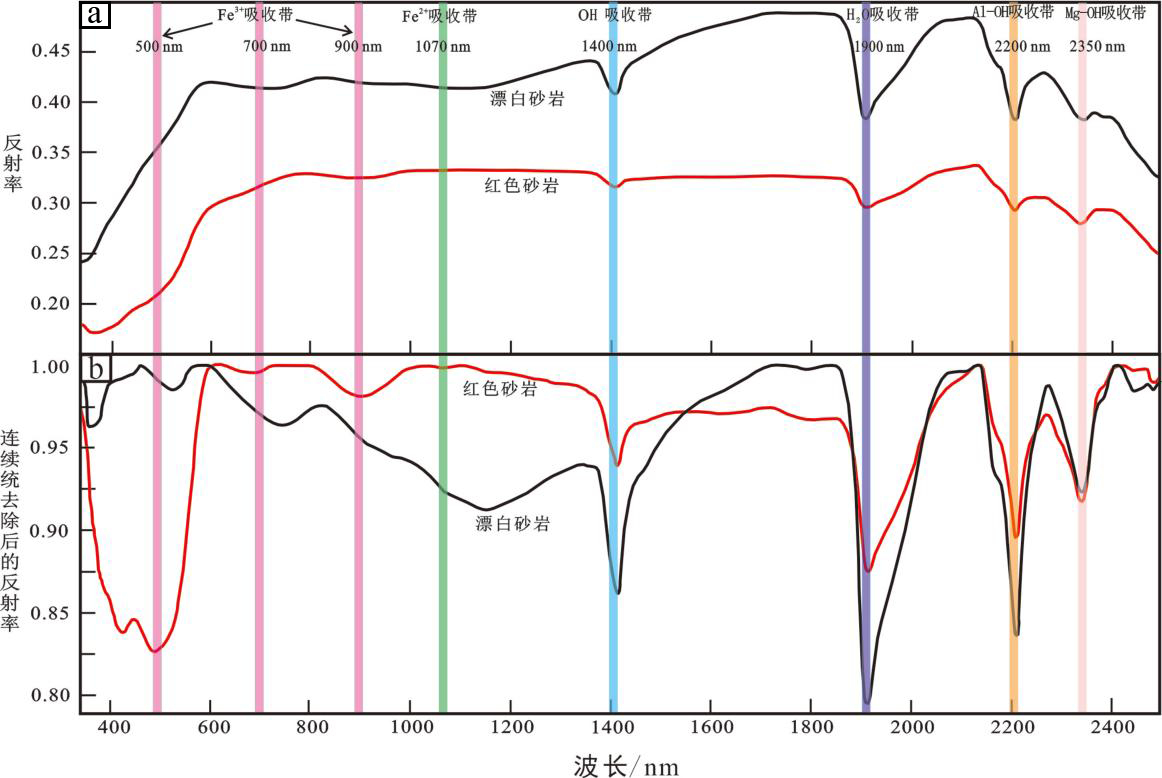
图4同一沉积纹层红色和漂白砂岩的原始光谱反射曲线(a)及连续统去除之后的光谱特征图(b)
图5红色砂岩LA-ICP-TOFMS微量元素mapping图像
3.3 Cu-Pb-Zn 等成矿金属元素与 Fe 元素协变关系
通过 Matlab 和 Excel 软件对本次红色砂岩残留体代表性区域 LA-ICP-TOFMS 元素扫面分析结果进行数据处理,绘制 Cu-Pb-Zn-Ag-U 等不同成矿金属元素与 Fe 元素的协变关系图解(图6),其中 V 元素为对V50、V51元素求和后的结果。
根据 Cu-Pb-Zn-Ag-U 等成矿金属元素与 Fe元素之间的协变关系的不同,可将其分为 3 类:①Pb、 Zn 元素与 Fe 元素表现为显著正相关性,随着 Fe 元素含量的上升,Pb 和 Zn 元素的含量也随之明显上升。②As、Co、Cu、U元素与Fe元素之间的相关性仅在 Fe 含量超过 105 μg/g 左右时表现显著,而小于此数值时As、Co、Cu、U元素含量几乎不随Fe元素含量变化而变化。具体而言,Cu和U元素仅在Fe含量超过 8×10⁴ μg/g 时表现出显著正相关关系,As 元素在 Fe含量超过 7×10⁴ μg/g 时显著正相关,而 Co 元素在 Fe含量超过6×10⁴ μg/g时显著正相关。在Fe含量较低时,这些元素和 Fe 元素之间缺乏明显的相关性。 ③Se、Ag 和 V 元素在 Fe 元素含量升高时,元素含量也有一定程度的缓慢升高,呈微弱正相关,其含量变化相对较为有限。
3.4 同一沉积纹层红色和漂白砂岩蚀变黑云母特征
乌拉根铅锌矿床克孜勒苏群同一沉积纹层红色和漂白砂岩不同部位绿泥石化黑云母电子探针主量元素含量如表1和图7所示,发现红层砂岩与 “漂白”砂岩中绿泥石化黑云母主量元素成分存在明显不同,红色砂岩中黑云母 SiO2含量 30.46%~35.55%、Al2O3 含量 12.47%~18.08%、TiO ₂ 含量 1.84%~2.17%、FeOT含量 11.67%~23.34%、MgO 含量 7.36%~11.35%、K2O 含量 5.48%~6.67%,而“漂白”砂岩中黑云母 SiO2含量 39.58%~43.12%、Al2O3 含量 21.18%~27.38%、TiO ₂ 含量 0.01%~0.69%、 FeOT含量 3.04%~7.65%、MgO 含量 1.66%~6.34%、 K2O 含量 1.00%~2.99%。由此可见,与红色砂岩中黑云母成分相比,“漂白”砂岩中黑云母 TiO₂、FeOT、 MnO、MgO、Na2O、K2O等组分含量普遍降低,而SiO2、 Al2O3等组分含量明显升高。Fe2O3和 FeO 含量采用 Li et al.(2020)黑云母电子探针数据计算方法获得,可知红色砂岩中黑云母 Fe3+ /(Fe2+ +Fe3+)比值介于 0.13~0.32,而漂白砂岩中黑云母 Fe3+ /Fe2+ 比值均为 0,指示“漂白”过程中黑云母在还原性流体作用下,发生绿泥石化并伴随有大量Fe3+ 被还原为Fe2+。

图6红色砂岩As、Co、Cu、Pb、Se、U、Ag、V、Zn元素与Fe元素相关性散点图
表1同一沉积纹层红色和漂白砂岩蚀变黑云母主要元素含量及特征对比(%)


图7同一沉积纹层红色和“漂白”砂岩(WG18样品)中不同部位(a、b、c)蚀变黑云母测点SiO2、Al2O3、TiO2、K2O、MgO、FeOT、 MnO、Cr2O3含量和Fe2+ /(Fe2+ +Fe3+)比值散点图(d)
4 讨论
4.1 红色砂岩成矿金属元素赋存状态
岩石中微量元素能以独立矿物、类质同象、流体包裹体、吸附态等多种形式产出,而Cu-Pb-Zn-U 等成矿金属元素在下白垩统克孜勒苏群红色砂岩 (矿源层)中相对富集(李志丹等,2013;Xue et al., 2014),但其含量低,赋存状态尚不清楚。本次岩相学观测和LA-ICP-TOFMS元素mapping数据结果显示成矿金属元素在碎屑颗粒中含量很低,而在胶结物中含量较高,且其空间分布与铁(Ⅲ)的氧化物与氢氧化物(IOH)产出密切相关(图5)。具体来讲,在铁(Ⅲ)的氧化物与氢氧化物范围内成矿金属元素含量很高,且主要呈相对均匀分散的面状分布,指示成矿金属元素可能主要以类质同象或吸附态形式产于铁(Ⅲ)的氧化物与氢氧化物中,而非微细包裹体形式产出。成矿金属元素若以类质同象形式存在,其可能以金属离子置换Fe(Ⅲ)的方式进入铁 (Ⅲ)氧化物与氢氧化物晶格,但考虑到成矿金属元素与 Fe 元素含量整体上具有明显正相关关系(图6),而非负相关关系,指示成矿金属元素在铁氧化物与氢氧化物中并非以类质同象形式存在。
在 Cu-Pb-Zn-Ag-U 等成矿金属元素与 Fe元素协变关系图解(图6)中,Fe元素与Cu、Pb、Zn等金属元素呈明显正相关关系,而与 As、Co、Cu、U、Ag、V、 Se元素只有当Fe含量>105 μg/g时才具有明显正相关关系,而当Fe含量较低时则无明显相关关系。这可能与红色砂岩中吸附剂(如铁(Ⅲ)氧化物与氢氧化物、黏土矿物)和成矿金属元素被吸附能力(如 Pb2+ >Zn2+ >Co2+ >Cu+ >Ag+)不同有关(Zielinski et al.,1983;Metcalfe et al.,1994)。一方面,高岭石、蒙脱石等低铁含量黏土矿物吸附能力相对较弱,而铁 (Ⅲ)的氧化物与氢氧化物吸附能力较强;另一方面,Pb2+、Zn2+ 等成矿金属离子易于被吸附,而 Co2+、 Cu+、Ag+等成矿金属离子难以被吸附(Zielinski et al.,1983;Metcalfe et al.,1994)。也即当Fe元素含量低时,高岭石、蒙脱石等黏土矿物吸附能力相对较弱,仅有Pb、Zn等易吸附的成矿金属元素能被吸附,而 Cu-Ag-Co等难吸附成矿金属元素则被吸附较为有限;只有当 Fe 含量很高时,铁(Ⅲ)的氧化物与氢氧化物吸附能力强,Cu-Pb-Zn-U-Ag等成矿金属元素均能被有效吸附。综上所述,笔者初步认为下白垩统克孜勒苏群红色砂岩中成矿金属元素可能主要以吸附态赋存于铁(Ⅲ)的氧化物和氢氧化物表面,而非硅酸盐相态产出。
4.2 红层“漂白”成因
目前,普遍认为红层“漂白”与铁(Ⅲ)的氧化物与氢氧化物溶解有关,其成因存在油气、H2S、有机酸等还原性有机流体和富CO2高密度流体水岩反应两种模式(马艳萍等,2007;王乐民等,2016;Gao et al.,2022)。在乌拉根铅锌矿区,红层“漂白”主要发生于下白垩统克孜勒苏群第五岩性段(顶部及上部),处于较高的层位,推断其很可能与油气等低密度还原性流体活动有关,而非富含 CO2高密度流体 (Gao et al.,2022)。“漂白”砂/砾岩中存在较多油渍、油污及沥青等有机质残留物质(韩凤彬等,2012;董新丰等,2013),在紫红色与灰白色砂岩接触的界限附近的灰白色砂岩内也能观测到有油气活动迹象 (Gao et al.,2019,2022),在漂白砂/砾岩石英碎屑、碳酸盐胶结物和闪锌矿硫化物中还能看到含油气的流体包裹体产出(韩凤彬,2012)。同时,克孜勒苏群砂砾岩也是乌恰盆地及外围重要的油气储层,上覆阿尔塔什组膏盐层及泥质白云岩为区内良好的沉积盖层,且克孜勒苏群砂砾岩储层存在着多期次油气充注活动(韩凤彬,2012;李志丹等,2013),能够形成较大规模的工业油气藏(如阿克莫木油气田等)和油苗(如杨叶油苗等)。此外,红层“漂白” 常因其空间分布与深部油气藏和(或)烃类运移关系密切,被认为是油气存在及其逸散的重要标志,如鄂尔多斯盆地延安组砂岩(刘池洋等,2006)。因此,乌拉根铅锌矿区红层“漂白”很可能与油气活动有关。
乌拉根铅锌矿床同一沉积纹层红色和“漂白” 砂岩岩相学观测对比,发现红色砂岩以产出铁(Ⅲ) 的氧化物与氢氧化物为特征,红层“漂白”过程与铁 (Ⅲ)的氧化物与氢氧化物色素溶解有关。与同一纹层红色砂岩相比,“漂白”砂岩中高岭石、蒙脱石等黏土矿物含量明显增加,钾长石、斜长石等矿物含量降低,绿泥石化黑云母蚀变程度增强。本次红色砂岩和“漂白”砂岩中黑云母电子探针数据(图7),也显示“漂白”砂岩中黑云母 TiO2、FeOT、MnO、 MgO、Na2O、K2O 等主量组分含量明显降低,Fe3+ / (Fe3+ +Fe2+)比值也明显降低,而SiO2、Al2O3等主量组分含量明显升高,表明红层“漂白”可能与还原性酸性流体水岩作用有关。此外,在红色砂岩和灰白色砂岩中均能看到大量的方解石胶结物、斜长石等矿物碎屑存在,这表明与红层“漂白”有关的流体酸性也不可能太强。因此,笔者认为红层“漂白”是因油气还原改变了红色砂岩氧化还原条件而使得 Fe (Ⅲ)的氧化物与氢氧化物色素还原溶解,而不是有机酸还原或大幅降低砂岩环境中pH值而使Fe(Ⅲ) 的氧化物与氢氧化物色素发生酸性溶解的结果。
4.3 红层“漂白”成矿意义
陆相红层之所以显红色,主要是因在其砂/砾岩碎屑颗粒表面和胶结物中有 Fe(Ⅲ)的氧化物与氢氧化物色素(如红色赤铁矿、黄褐色针铁矿)产出,而前人多认为 Fe(Ⅲ)的氧化物与氢氧化物是在成岩期由不稳定的镁铁质矿物(如辉石、角闪石、黑云母等)发生原地氧化分解形成或沉积期搬运堆积而来(Turner,1980;彭华和吴志才,2003;Brown, 2005)。本研究发现下白垩统克孜勒苏群红色砂岩中有大量的铁(Ⅲ)的氧化物与氢氧化物产出,主要以胶结物形式存在,常见其包裹在碎屑颗粒表面,但在这些碎屑颗粒间接触部位未见有铁氧化物与氢氧化物产出(图3e、f),表明铁的氧化物与氢氧化物可能形成于成岩早期,而并不是沉积期搬运而来。红色砂岩中所见的铁(Ⅲ)的氧化物与氢氧化物和黑云母、角闪石等镁铁矿物空间关系密切,常见铁(Ⅲ)的氧化物与氢氧化物沿黑云母解理呈线状、脉状产出或在环绕黑云母矿物碎屑颗粒产出 (图3g),指示其与成岩早期黑云母等镁铁矿物原地氧化水解有关。
考虑到陆相红层(碎屑岩及其所含层间水)作为红层盆地内砂岩型铜、铅锌、铀等金属成矿的重要矿源层(Kirkham,1989;Brown,2005;Hitzman et al.,2005),其中镁铁质矿物(如辉石、角闪石、黑云母)和钾长石等碎屑富含 Cu-Pb-Zn 等成矿金属元素(Metcalfe et al.,1994),特别是黑云母中锌元素含量能占全岩锌含量的 80%,铅元素含量也可占相当大比例(Hammerli et al.,2015)。也即在成岩早期不稳定的镁铁质矿物和钾长石碎屑发生原地氧化水解,除形成铁(Ⅲ)的氧化物与氢氧化物色素外,还会释放出的大量 Cu-Zn-Pb等成矿金属元素。这些成矿金属元素会直接吸附于铁(Ⅲ)的氧化物与氢氧化物、高岭石与蒙脱石等黏土矿物表面,而非赋存于硅酸盐矿物晶格之中。红层中其成矿金属元素赋存状态由硅酸盐相转变为吸附态,这为后期红层“漂白”过程中被酸性、还原性流体淋滤萃取创造了有利条件。同时,陆相红层淋滤萃取实验也已经证实 Cu-Pb-Zn 等成矿金属元素可浸取性很强,并且在同等条件下年轻的粗粒红色碎屑岩能够相对更快地释放出更多成矿金属元素(Wedepohl,1978; Parnell et al.,2021)。由此可见,下白垩统克孜勒苏群陆相红层作为区域砂岩型铜铅锌铀矿床的重要矿源层,红层“漂白”也即红层中铁(Ⅲ)的氧化物与氢氧化物溶解过程,必然会伴随着其所吸附的铅锌等成矿金属元素溶解释放而形成成矿流体,这可能是红层“漂白”作为区域砂岩型铜铅锌矿床找矿标志的重要原因。
此外,乌拉根矿区红色和“漂白”砂岩可见光-短波红外反射光谱测量,发现其在 500 nm、700 nm、 900 nm 处 Fe³⁺吸收带和 1070 nm 处 Fe²⁺吸收带差异明显(图4),据此能够快速有效识别红层砂岩“漂白”现象。在此基础上,借助于可见光-短波红外反射光谱技术与无人机高光谱等现代技术方法,能快速查明红层“漂白”的空间分布,识别成矿流体运移通道,为山前/山间盆地砂岩型铜铅锌铀矿高效勘查提供智能化解决方案。这对正确理解新疆塔西南地区砂岩型铜铅锌矿床成矿金属来源和推动找矿突破具有重要的理论价值和实际意义。
5 结论
(1)下白垩统克孜勒苏群红色砂砾岩富含 Cu-Zn-Pb 等成矿金属元素,且主要以吸附态赋存于铁 (Ⅲ)的氧化物与氢氧化物,易于淋滤萃取,而成为区域重要的矿源层。
(2)红层“漂白”成因可能与区域油气还原有关,有机流体能够改变红色砂岩氧化还原条件而使其中铁(Ⅲ)的氧化物与氢氧化物色素发生还原性溶解。
(3)红层“漂白”过程可能伴有 Fe-Cu-Zn-Pb 等成矿金属元素的淋滤萃取,为砂岩型金属矿床形成提供金属来源,是区域砂岩型金属矿床重要的找矿标志。

