摘要
冀东地区地热资源丰富,尤以中低温对流型地热系统广泛分布。本文基于区内8处典型地热异常区的水文地质调查、地球物理勘探、水化学分析与同位素测试等综合勘查成果,系统研究了冀东中低温对流型地热系统的热储结构特征及各子系统间的耦合关系。研究结果表明,地热异常区主要分布于太古宙变质岩与侏罗纪花岗质侵入岩接触带附近的构造交汇部位。地热水温度为27.9~54.9 ℃,水化学类型以SO4-Na 型为主,热水来源于大气降水,循环深度2500~3600 m。热储系统可划分为5个子系统:补给系统(水源)、生热系统(热源)、运移系统(通道)、储集系统(热储)和保温系统(盖层)。其中,保温系统普遍缺失或保温效应较弱;储集系统呈上宽下窄的碗状结构,厚度可达数百米;运移系统上部呈圆柱状,下部渐变为圆锥状,埋深介于数百米至数千米;生热系统埋深最大,热源主要来自地壳深部及地幔热流。整体热储结构呈现典型的“树”状三维空间架构。
关键词
Abstract
The eastern Hebei region is rich in geothermal resources, with medium-low temperature convective geothermal systems being widely distributed. Based on comprehensive exploration results—including hydrogeological surveys, geophysical exploration, hydrochemical analyses, and isotope tests from eight typical geothermal anomaly areas in the region—this study systematically investigates the geothermal reservoir structure and the coupling relationships among subsystems within the medium-low temperature convective geothermal system in eastern Hebei. The results show that the geothermal anomalies are mainly distributed at structural intersections near the contact zone between Archean metamorphic rocks and Jurassic granitic intrusions. The temperature of the geothermal water ranges from 27.9 ℃ to 54.9 ℃, and the hydrochemical type is predominantly SO4-Na. The geothermal water originates from atmospheric precipitation and circulates at depths between 2500 m and 3600 m. The thermal reservoir system can be divided into five subsystems: the recharge system (water source), the heat generation system (heat source), the migration system (channel), the storage system (thermal reservoir), and the insulation system (caprock). Among these, the insulation system is generally absent or exhibits weak thermal preservation effects; the reservoir system displays a bowl-shaped structure that is wide at the top and narrow at the bottom, with a thickness of up to several hundred meters; the upper part of the migration system is cylindrical, transitioning to a conical shape in the lower part, and its burial depth ranges from several hundred to several thousand meters; the heat generation system is buried at the greatest depth, with its heat source derived mainly from deep crustal and mantle heat flow. The overall geothermal reservoir structure exhibits a typical "tree-like" three-dimensional spatial configuration.
0 引言
中低温对流型地热系统是指温度低于 150℃,地下深处没有附加热源,在正常或略为偏高区域热背景条件下,出现在孔隙-裂隙介质或断裂破碎带中的地下热水环流系统(汪集旸等,1993)。由于其自身的特点,受地区限制较高温水热系统相对较小,因此在自然界分布范围较广,是中国主要的地热资源类型(黄力军,2021)。其具有开发过程简单、快速、投资少、见效快、污染少等特点(徐世光和郭远生,2009),只要温度、流量具一定规模的地区即可直接开发利用,特别适合广大农村和偏远山区 (李修成等,2016;陈鹏等,2017)。此外,中低温对流型地热系统中的地热流体往往富含贵金属、稀土、放射性元素乃至氦等稀有气体,是研究地球表层热状态、热水成岩、成矿作用和低温地球化学等领域最为理想的大型天然实验室(汪集旸等, 1993)。因此,越来越多国内的水文地质学家、地球化学家甚至矿床学家把更多的注意力转移到中低温对流型地热系统上来。
20 世纪60年代,Muffler(1979)率先开展了对中低温对流型地热系统研究工作,此后国内众多学者也在中低温对流型地热系统形成机制、地热水资源评价、水文地球化学、勘查方法及地热水化学模拟方面开展了大量的研究(陈墨香,1988;孙春晖, 1999;史猛等,2019;王贵玲和蔺文静,2020;黄力军,2021)。但是,自 20 世纪 60 年代美国地热学家 White提出中低温对流型地热系统的经典模式以来 (White,1968①),一直沿用至今,虽有不同学者在此基础上略有补充完善,但不够系统全面,未对中低温对流型地热系统的具体形态、结构及各子系统之间的关系做进一步划分。
冀东地区地热资源丰富,特别是中低温对流型地热资源在北部山区广泛分布(王玉珏等,2023;王瑞鹏等,2024)。但由于目前对其地热资源赋存机理仍缺乏较深入的研究,在地热井施工过程中,往往凭经验开展,导致地热井的施工无法有效定位热储中心。本研究通过对冀东地区的中低温对流型地热资源勘查过程中取得的大量地热地质、水文地质、地球物理、水化学分析、同位素测量等方面资料的全面分析,结合以往学者研究的成果(李娟等, 2007;张德忠等,2013;王卫星等,2014),对冀东地区的中低温对流型地热系统特征及成因模式开展了研究,提出冀东中低温对流型地热系统热储由补给系统(水源)、生热系统(热源)、运移系统(通道)、储集系统(热储)和保温系统(盖层)5 个子系统组成,热储空间整体呈“树”状分布的特征。本研究有望为冀东地区今后开展中低温对流型地热系统勘查、开发、利用提供重要的现实和理论意义。
1 地热地质背景
研究区大地构造位于中朝准地台燕山台褶带马兰峪复背斜、山海关台拱,区内地层出露齐全,地壳具有传统槽台学说中典型的“地台二元结构”,即由太古宙、古元古代组成的变质基底和中、新元古界及上覆地层组成的沉积盖层两个主要部分组成。受构造作用影响,太古宙、古元古代变质岩在北部马兰峪复背斜核部和山海关台拱大面积出露地表。马兰峪复背斜两翼被沉积岩组成的盖层覆盖,盖层由正常沉积地层和火山地层构成,地层层序较齐全 (图1)。南部平原区由巨厚的第四系和古近系—新近系松散沉积物覆盖。
本区经历了长期、多旋回的复杂构造演化,其中燕山运动是关键的变革期,以强烈褶皱、逆冲推覆和广泛岩浆侵入为特征,基本奠定了现今复杂的构造格架。规模宏大的东西向构造带构成区域构造骨干,其内部断裂多具韧性-脆性复合变形特征,结构分带清晰:从核部的滑动面向外,依次发育断层泥、糜棱岩化带、片理化带及挤压破碎带。
现代构造活动主要表现为NE、NNE及NW向断裂。这些断裂与古老的东西向构造相互交切,共同构成了主要的导水-导热构造网络。中低温对流型地热资源的形成与分布,严格受该网络控制,尤其是不同方向断裂的交汇部位,它们为大气降水深循环和深部热流体上涌提供了优势通道与储集空间,直接决定了地热异常区的空间展布格局。
中生代时期,华北克拉通东部的岩石圈结构受太平洋板块的俯冲作用,而遭到破坏,地幔物质在中国东部岩石圈减薄了的区域向上侵位,下地壳物质熔融(Zhang et al.,2014),从而在马兰峪复背斜核部形成了一系列的侵入岩体。主要分为两期,即印支期和燕山期,在区内形成了都山、肖营子、杨杖子、水胡同等大小数十个花岗质岩体、岩株,同时伴有两期岩浆活动形成的各类脉岩或岩墙。这些中生代侵入岩体与围岩(主要为太古宙变质岩)的接触带,是构造应力最为集中的部位,极易形成密集的裂隙系统和角砾岩化带。这些接触带与先存断裂系统相结合,共同构成了本区中低温对流型地热系统中最主要、最富水的热储空间。因此,中生代的岩浆活动不仅塑造了区域的岩石组成,其形成的侵入接触构造与先存断裂网络的耦合,为地热资源的最终定位提供了决定性的赋存场所。

图1研究区大地构造位置图(a)与地热地质简图(b)
2 样品采集与测试
本研究对区内的8处中低温对流型地热异常区开展了水样采集与测试工作,共采集水样 10 组,取样时间为 2019 年 8 月。所取水样为从地热井直接抽取的地下热水,在抽水井现场添加相应试剂,使用本色PE瓶作为采样容器。采样前,先以纯净水润洗容器,再用待采集水样润洗 3 次,再取满水样,排出水样瓶中空气,用石蜡封口,胶带密封,保证水样不与外界接触,贴好水样标签,填写送样单,样品自采样之时起在 24 h 内送实验室进行检测。整个采样过程参照《地热资源地质勘查规范》(GB/T11615-2010)和《地下水采样技术规程》(DZ/T 0420-2022) 执行。在野外测定了地热水的物理参数,地热流体全分析及同位素分析全部在国土资源部地下水矿泉水及环境监测中心进行,分别采用等离子体发射光谱仪(iCAP6300)、同位素分析仪(L2130i)进行测试。
3 地热资源特征
冀东地区利用温泉热水历史悠久。目前,共发现中低温对流型地热异常区 8 处,均分布于北部构造剥蚀台地和构造剥蚀丘陵区的河漫滩或沟流阶地等低洼处(图1)。地热异常区面积狭小,一般小于 1 km2,或呈点状零星分布,仅遵化市汤泉村地热异常区相对面积较大,达到了1.92 km2(表1)。地表出露形式主要以温泉为主,同时还有后期施工的地热井,泉口或井口水温 27.9~54.9℃。热水中阳离子以Na+、Ca2+ 和K+ 为主,阴离子主要有SO4 2-、HCO3-、 Cl-,水化学类型以 SO4-Na 型为主,还有 Cl-Na 型、 SO4·Cl-Na 型和 HCO3·SO4-Na·Ca 型(徐一鸣等, 2023)。地热异常的分布严格受断裂控制,大部分分布于深大断裂附近的断裂交汇处或转折端。异常区多分布在太古宙片麻岩、变粒岩与侏罗纪花岗质侵入岩接触带附近(程立群等,2020;徐一鸣等, 2023)。
表1冀东中低温对流型地热异常区特征

4 热储特征
4.1 补给系统(水源)
利用本研究采集的 10 件地热水样测试的 H、O 稳定同位素数据(表2)绘制 δD-δ18O 关系图(图2)。从图2中可以看出,热水样点大多落在大气降水线附近,反映了研究区地下热水来源于大气降水(张芬娜等,2025)。
以往研究表明,冀东中低温对流型地热水中可溶性 SiO2的含量与温度存在明显的正相关性(李娟等,2007;王卫星等,2014;徐一鸣等,2023),地热水中可溶性SiO2的含量可以作为一种化学温标来指示该地区热储中地热水的温度。根据各异常区地热水中可溶性 SiO2的含量,利用地热温标计算公式估算出各异常区深部热储温度见表3。由表3可知,冀东中低温对流型地热深部热储温度一般为 90~120℃,最高可达130℃。
表2研究区地热水氢氧稳定同位素测试数据
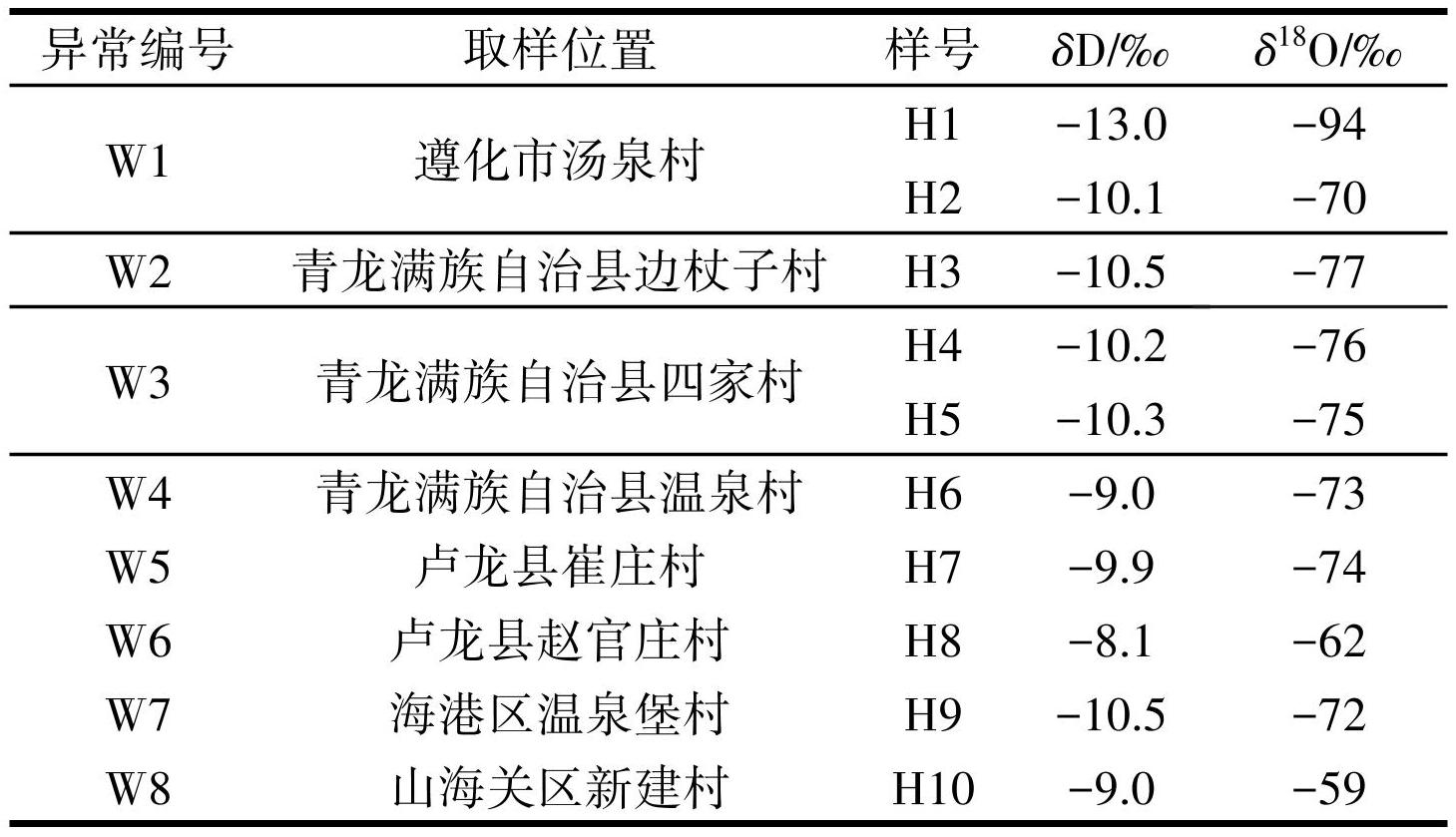
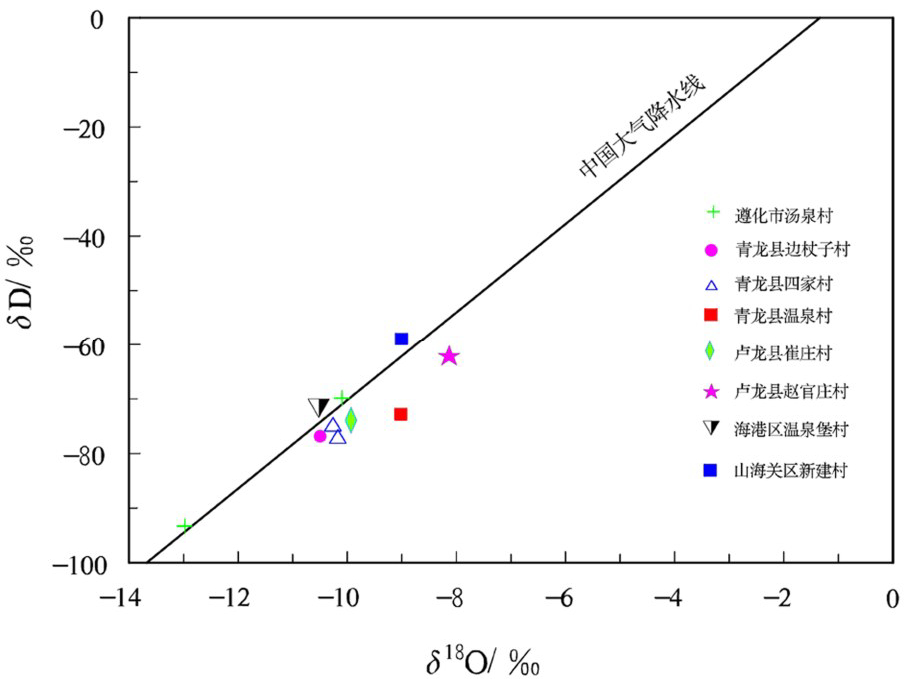
图2冀东中低温对流型地下热水δD-δ18O关系图
中低温对流型地热是大气降水入渗经深循环后上升至地壳浅部而形成的地热资源,热水温度主要与循环深度有直接关系。可以根据下式估算地热水的循环深度:
(1)
式(1)中:Z—热水循环深度(m);TZ—热储温度(℃);T0—常温带温度(℃);G—地热增温级(m/℃); Z0—常温带深度(m)。
本研究根据对分布在冀东山区的 98 个机民井连续地温测量数据进行统计分析,在所有机民井中恒温带温度为 12~13℃的所占比例最多,为 39%,通过计算所有机民井恒温带温度中位数为 12.5℃,因此本次计算 T0常温带温度采用值为 12.5℃;在所有机民井中恒温带深度为20 m的所占比例最多,恒温带深度中位数也同样为20 m,因此本次计算Z0常温带深度采用值为20 m(赵鑫鑫等,2022)。地热增温级主要受地质构造、岩石热导率及岩浆活动等因素影响,冀东山区范围内地热增温级不同区域变化较大,为了便于统一标准,本次计算地热增温级G选取了全球平均值,即 33 m/℃参与计算(李娟等, 2007;程立群等,2020)。
由表3深部热储温度及地热水循环深度计算结果表可知,冀东中低温对流型地热水循环深度较大,一般在2500~3600 m,最大可达3900 m。
表3深部热储温度及地热水循环深度

4.2 保温系统(盖层)
在冀东中低温对流型地热系统中,盖层作为直接覆盖于热储层之上的地质单元,对地热资源的保存与热状态维持具有关键作用。其厚度、热绝缘特性及空间分布连续性,直接影响地下热水的赋存温度、向上热散失速率以及开采过程中的热效率。
研究区地热资源主要分布于冀东北部基岩山区,多以天然温泉形式出露地表,少数通过人工地热井进行开采。地热井深度普遍较浅,介于数十米至数百米之间,往往在钻进仅数米或十数米后即可揭获热水,且水温随深度增加呈递增趋势。本区地热异常带内基岩广泛裸露,第四系覆盖层极为薄弱,一般厚度不足 20 m,且岩性以渗透性较强的砂砾石为主,黏性土层不发育、厚度小、空间分布不连续,导致其热绝缘性能较差,难以形成有效阻隔热流向上逸散的结构性盖层。
因此,综合地质结构与岩性特征分析认为,冀东北部中低温对流型地热系统基本缺乏连续、厚层且热物性良好的盖层保护,现有第四系沉积对地热资源的保温作用极为有限。这一地质条件导致该区地热资源以浅层快速循环和天然排泄为主要特征,热保存条件整体较差,也制约了深部高温热资源的形成与聚集。
4.3 储集系统(热储)
根据野外实地调查,冀东中低温对流型地下热水储层可分为两类:
(1)孔隙型热水储层
孔隙型热水储层仅在卢龙县崔庄村和卢龙县赵官庄村地热异常区分布,该类热储主要赋存于厚 5~20 m 第四系冲洪积松散沉积层中,由砂砾石层组成,厚度较薄,且不均一,受深部热储层的顶托补给,热水与孔隙冷水混合而流出地表,利用价值不大。
(2)基岩裂隙型热水储层
基岩裂隙型热水储层广泛分布于冀东地区所有地热异常区,构成该区中低温对流型地热系统的主要储集类型。从岩性组成来看,该类热储可划分为两大类:其一为太古宙片麻岩和变粒岩构成的变质岩系,其二为侏罗纪花岗岩组成的侵入岩体,二者多呈侵入接触关系。除卢龙县崔庄村地热异常区仅见变质岩热储外,其余 7 处异常区热储层均为此两类岩性的组合体。地下热水主要赋存于受断裂构造或岩浆侵入作用形成的裂隙系统与破碎带中,其储集空间具显著的非均质性和构造控储特征。钻孔资料表明,在断裂发育强烈地段,井孔普遍表现出较大的涌水量和相对较高的水温,反映出构造对热储富水性与热状态的控制作用。平面上,热储多呈带状展布,其空间几何特征(如宽度、长度和深度)及热液参数(富水性、温度)严格受断裂破碎带及其影响范围的控制(张卓等,2025)。

图3青龙满族自治县四家村地热异常区电测深平面成果图
为深入揭示热储垂向结构的分布规律,本研究以青龙满族自治县四家村地热异常区为典型实例,系统开展了覆盖全区的高精度视电阻率垂向电测深扫面工作。在完成野外数据采集后,对全区测点数据进行了一体化处理与反演解释,分别提取了 AB/2 为 150 m、340 m、500 m 及 700 m 共 4 个深度的视电阻率数据,并据此绘制了不同深度的视电阻率平面等值线图(图3)。分析结果表明,视电阻率异常范围随深度增加呈现明显变化,总体表现为异常面积逐渐收敛、形态趋于集中的特征。结合该区已有地热井的测温及产能数据,这一电性结构特征有效揭示了热储在垂向上的空间变化规律:热储整体呈碗状结构,即随深度增加,其平面分布范围逐步缩小。
该结构特征主要受控于温压条件下流体运移机制与裂隙系统的开闭性变化。近地表处,由于围压较低,裂隙网络较为发育,热储开放性强,地热水流动速度减缓,侧向扩散作用增强,导致热水分布范围较大;随深度增加,岩体受围压增大及构造作用减弱的影响,裂隙趋于闭合,热储结构更趋封闭,流体主要以较快速度沿主干断裂或优势通道向上运移,热储空间因而变得狭小且集中。
4.4 运移系统(通道)
地下水深循环到一定深度就能形成地下热水,但要形成中低温对流型地热资源,就一定需要有通道将地热水运移到浅部。为查明中低温对流型地热系统中深部热液的运移通道特征,本研究综合采用了视电阻率垂向电测深扫面与可控源音频大地电磁测深(CSAMT)等方法,对热储结构进行了精细探测。
首先,在全区开展视电阻率垂向电测深扫面工作的基础上,选择异常核心区布设了一条方位 60°、长度 3600 m 的 CSAMT 剖面,以获取深部电性结构的高分辨率信息。剖面结果显示(图4),纵向上电阻率整体呈现自上而下逐渐增高的趋势。地表附近存在明显低阻层,推断为第四系松散沉积物响应,其厚度为3~10 m。在剖面中识别出6处等值线明显向下挠曲的低阻异常区,推测由断层或裂隙带引起。其中5条断裂延伸较浅,1条主断裂延伸深度较大,至少可达-1000 m标高,表明其具备成为深部热液向上输运主干通道的条件。
结合区域地热地质调查与电测深扫面成果,判定该地热异常区处于两条断裂的交汇部位,这一构造配置为深部热液上涌提供了有利通道。在-500 m 标高以上,低阻带在剖面上呈“V”字形、空间上呈 “碗”状结构,解释为热储渗流系统,代表热水在浅部裂隙网络中的赋存与扩散空间;-500 m以下低阻带则呈带状(剖面)至圆柱状(空间)展布,推测为热液向上运移的主要路径,即运移系统。
上述电性结构特征表明,四家村地热系统具备典型的中低温对流型地热资源的“运移‐赋存”二元结构,断裂系统及其交汇部位控制着热液的上升与聚集,为地热资源的勘探开发提供了明确的地球物理依据。

图4青龙满族自治县四家村地热异常02线CSAMT测深综合解释断面图
4.5 生热系统(热源)
研究区所在的河北唐山和秦皇岛地区的大地热流值为 30~100 mW/m2(胡圣标等,2001)(图5)。其中大地热流高值区主要分布在冀东南部的平原区,热流值为70~100 mW/m2,该区内大面积分布有层状热储。而中低温对流型地热资源所在的冀东北部山区大地热流值一般为30~40 mW/m2,低于华北地区平均大地热流值(68.5 mW/m2)(汪洋等, 2001),不具备高热异常,属正常的甚至较低大地热流背景区。虽然冀东地区侵入岩体大量分布,中低温对流型地热区大多分布于岩体周边,但这些岩体均为燕山期侵入形成,年龄距今均在 100 Ma 以上,岩体直接出露地表,浅部余热已散失殆尽,对现今地温场无影响。侵入岩中所含的天然放射性元素虽然很多,但只有铀、钍、钾 3 个元素因具有足够的丰度且其半衰期可与地球的年龄相比拟而被列为主要生热元素。假设地壳最上部10 km厚度内放射性元素均匀分布,通过将这些岩体中铀、钍、钾 3 个元素含量值带入岩石放射性生热率计算公式(Rybach,1976):
(2)
式(2)中,A 为岩石生热率(μW/m3);ρ 为岩石密度(g/cm3);CU 为铀的含量(10-6);CTh 为钍的含量 (10-6);CK为钾的含量(%)。
计算得出,冀东侵入岩体岩石生热率值在 0.41~1.24 μW/m3(程立群等,2020),与华北地壳的平均放射性生热率0.76~0.90 μW/m3 较为接近(汪洋等,2001),甚至略低于中国大陆平均放射性生热率 1.30 μW/m3,说明这些岩体放射性生热元素的衰变生热并不能构成特殊热源。因此,冀东中低温对流型地热系统热源可能主要来自于地壳深部和地幔。

图5冀东地区大地热流分布图
5 热储结构及成因模型
冀东北部山区在大地构造上隶属于燕山台褶带,其新生代以来的强烈抬升作用塑造了现今高峻的地势地貌,并导致前寒武纪变质基底与中生代花岗质侵入岩广泛裸露,为地热流体的形成与运移提供了宏观地质背景。该区域最为显著的地质特征在于其极为发育的断裂构造系统,一系列东西向、北东向及北北东向的深大断裂相互交织、迭置,构成了一个密集且切割深度的网络状裂隙系统。这些断裂及其伴生的次级构造,不仅是区域应力场的直接响应,更为大气降水向地壳深部入渗提供了良好通道。
具体而言,来自大气降水和地表径流的冷水,在山区高地势提供的巨大势能驱动下,沿着张性或张扭性断裂带、裂隙网络以及低渗透岩层中的构造弱面,向地壳深部运移。流体可沿着这些优势通道向下渗透至2000~4000 m的深度。在此过程中,随着循环深度的增加,围岩温度在正常或略偏高的区域大地热流背景下持续升高,流体通过传导方式从围岩中获取热量。同时,温度升高极大地激活了水-岩反应的化学动力学过程。热流体与花岗岩、片麻岩等围岩发生持续的、广泛的相互作用,促使岩石中的硅、钠、钾、硫酸根等矿物元素及组分逐步溶解并富集于热液中。这一过程不仅改变了水化学性质,形成了以 SO₄-Na 型为主的特征水化学类型,也显著提升了流体的热焓值,完成了从常温冷水到中低温热水的关键转变。
当经过加热和化学演化的地热水在深部遇到切割更深的活动断裂带时,系统的动力学状态发生根本性转变。在浮力效应(因热流体密度降低而产生)和深部流体压力共同构成的压力-密度差驱动下,热流体不再缓慢下渗,而是以热对流的形式,将这些深大断裂作为主干通道进行快速向上的纵向运移。这种快速的上升过程有效地减少了热量的途中散失。最终,热流体在静水压力与动水压力平衡的浅部,以天然温泉的形式涌出地表,或通过人工钻探成地热井被开采。部分流体在上升路径中,若遇到由构造遮挡或岩性变化形成的圈闭,便会在适宜的裂隙空间内聚集储存,形成具有直接开发利用价值的地热资源(图6)。
基于对上述过程的系统研究,笔者将冀东地区的中低温对流型地热系统解构为5个在功能上紧密耦合、依次作用的子系统:补给系统(水源)、生热系统(热源)、运移系统(通道)、储集系统(热储)和保温系统(盖层)。这5个子系统在三维空间中共同构建了一个极为典型的“树”状热储结构模型,生动地揭示了该系统地热流体的完整循环过程与资源赋存机制。
补给系统(水源):作为整个地热循环的起点,大气降水或地表径流在重力作用的驱动下,通过广泛发育的断裂网络与裂隙系统向下入渗,为深部水-岩相互作用与加热过程提供了最根本的流体来源。
生热系统(热源):该系统作为模型的最深部,热源主要来自地壳深部及地幔的热流,在正常或略偏高的区域大地热流背景下,为下渗的冷水提供持续的热量,是流体得以加热的能量基础。
运移系统(通道):该系统承担着流体汇集与输送的双重功能。其下部在一定深度呈“圆锥状”或 “根系状”,负责将经深循环加热后的热液有效汇集;上部则由相对陡峻的活动性断裂构成运移主干,是热液从深部向浅部进行快速、集中输送的核心通道。
储集系统(热储):当热液运移至近地表(通常在几百米以浅)时,由于围压显著降低,裂隙网络极度发育,系统由封闭的管道流转变为开放的弥散流。此处的储集系统呈现出“上宽下窄的碗状结构”或“伞状”的储集空间。热流体在此向周缘的次级裂隙网络中扩散、储集,并驱替原有的冷水,形成可供直接开采的热储层。
保温系统(盖层):冀东地区的保温系统普遍薄弱,保温效果有限。这直接导致了该区地热资源以中低温为主,且热流体易于在浅部散失或直接出露地表形成温泉。
综上所述,冀东中低温对流型地热系统的成因,是一个由“降水为源、构造导流、热流供能、深循加热、对流上升、成泉成储”共同驱动的完整过程。

图6冀东中低温对流型地热系统热储结构及成因模型
6 开发利用潜力
通过本研究发现,冀东地区中低温对流型地热资源温度适中(27.9~54.9℃),属于可直接利用的中低温地热资源;其分布严格受区域深大断裂控制,多集中于断裂交汇或转折部位,靶区明确。热储以基岩裂隙型为主,主要赋存于太古宙变质岩与侏罗纪花岗岩的断裂破碎带中,整体呈“上宽下窄” 的碗状结构。地下水沿断裂网络下渗至 2000~4000 m 深度,经正常大地热流加热后,在浮力和压力驱动下沿主干断裂上涌,最终以温泉或浅层地热井(通常井深<500 m)的形式出露,埋藏浅、循环速度快、勘探开发成本较低。
地热流体水化学类型以SO4-Na型为主,大部分热水中氟和偏硅酸均达到了矿水浓度,形成具有医疗价值的“氟水”和“硅水”,特别适宜发展温泉康养、休闲旅游等产业。地球化学温标估算深部热储温度可达90~130℃,表明热源稳定,具备可持续开发条件。
在利用方向上,除优先发展温泉康养旅游核心产业外,还可因地制宜用于供暖、温室农业等直接利用。但需注意,地热水因成分特殊不宜作为饮用水源,直接用于灌溉与工业锅炉也需谨慎,用于水产养殖时需预处理。资源开发必须遵循采灌均衡原则,加强动态监测与保护,以实现资源的可持续利用。总体而言,冀东中低温对流型地热资源兼具清洁能源属性与健康产业价值,在推动地方能源结构优化与康养旅游融合发展方面前景广阔。
7 结论
(1)冀东中低温对流型地热异常区一般面积不大,地表出露形式主要以温泉为主,同时还有后期施工的地热井,泉口或井口水温 27.9~54.9℃。热水中阳离子以 Na+、Ca2+、和 K+ 为主,阴离子主要有 SO4 2-、HCO3-、Cl-,水化学类型以 SO4-Na 型为主。地热异常的分布严格受断裂控制,大部分分布于山区深大断裂附近的断裂交汇处或转折端。
(2)根据 H、O 稳定同位素测试结果,热水来源于大气降水;根据可溶性 SiO2化学温标估算深部热储温度一般在 90~120℃,最高可达 130℃。地下热水循环深度2500~3600 m。
(3)冀东中低温对流型地热系统由 5 个子系统有机组成:补给系统(水源)、生热系统(热源)、运移系统(通道)、储集系统(热储)和保温系统(盖层),整体热储空间在三维结构上呈“树”状分布。其中大气降水为热储提供了源源不断的水源,来自于地壳深部和地幔的热量提供了热源,主干与主要断裂运移通道对应,次级裂隙网络为分支,最终在适宜构造-岩性部位形成热储层和地热显示。
注释
① White D E.1968. Hydrology activity and heat flow of the Steamboat Springs thermal system, Sashoe County, Nevada[R]. Washington D C: USGS Professional Paper.