摘要
矿床剥蚀速率与保存条件的定量评价是衔接成矿理论与矿产勘查的关键环节。传统地质温压计和同位素定年手段难以提供连续的时间-温度-深度约束,制约了古剥蚀面的恢复精度和矿体就位深度的判别能力。近年来,低温热年代学的快速发展为这一问题的解决提供了新的技术路径。本文围绕低温热年代学在矿床剥蚀速率定量研究中的应用,沿“方法进展→解译模型→应用范式→前沿挑战”的框架展开系统综述:在技术层面,重点梳理裂变径迹与(U-Th)/He 两大体系从依赖既定“封闭温度”作为单一热事件计时器,向耦合“辐射损伤积累”与“动力学退火”协同演化的非线性热路径模拟模型转变的技术脉络,其中裂变径迹体系实现了从表观年龄向围压径迹长度分布热史正演的跃迁,(U-Th)/He体系则完成了从球状扩散模型向考虑辐射损伤捕获效应和母核素分区的热动力学模拟升级,两者交融重塑了对部分退火带与部分保留带内连续热历程的定量反演范式。在此基础上,归纳了多矿物联合剖面、蒙特卡罗反演与空间采样协同设计等集成策略。在应用层面,提炼了控制方法选择的3个核心地质变量——矿床年龄、构造活跃度、后期热事件强度;建立了基于剥蚀量与成矿深度对比的三级保存等级:Ⅰ类(保存良好,剥蚀量小于成矿深度的 50%)、Ⅱ类(部分保存,剥蚀量为成矿深度的 50%~100%)、Ⅲ类(严重剥蚀,剥蚀量大于成矿深度);提出了剥露量约束与保存分区、冷却速率与矿体就位判别、保存窗口识别及热年代学-地球物理联合约束4条勘查转化路径,其中剥露量约束与保存分区技术成熟度最高,已在胶东金矿等地区成功应用,将剥蚀量估算误差从公里级缩小至百米级。当前研究仍面临热史反演多解性、多因素驱动分离困难及个例研究向大数据整合转型等挑战。未来,原位微区分析、超低温热年代学拓展及机器学习与大数据融合,将推动该领域从已知矿床的回顾性解释迈向未知区找矿潜力的前瞻性预测。
Abstract
Quantitative assessment of exhumation rates and preservation conditions of ore deposits is a critical link between metallogenic theory and mineral exploration. Traditional geothermobarometry and isotopic dating methods are generally incapable of providing continuous time-temperature-depth constraints, which limits the accuracy of paleo-exhumation surface reconstruction and the ability to determine emplacement depths of orebodies. In recent years, the rapid development of low-temperature thermochronology has offered a new technical approach to address this issue. This paper presents a systematic review of the application of low-temperature thermochronology to the quantitative study of ore deposit exhumation rates, following the framework of "methodological advances → interpretive models → application paradigms → frontier challenges". At the technical level, we focus on the evolutionary trajectory of the fission-track and (U-Th)/He systems, which have shifted from relying on a prescribed "closure temperature" as a single-event chronometer toward coupled nonlinear thermal-history models that incorporate "radiation damage accumulation" and "kinetic annealing" synergies. The fission-track system has progressed from apparent-age interpretation to forward modeling of thermal histories constrained by confined track-length distributions, whereas the (U-Th)/He system has advanced from spherical diffusion models to thermokinetic simulations that account for radiation damage trapping effects and parent-nuclide zoning. This integration has reshaped the paradigm for quantitatively inverting continuous thermal trajectories within the partial annealing zone and the partial retention zone. On this basis, we summarize integrated strategies including multi-mineral joint profiles, Monte Carlo inversions, and coordinated spatial sampling designs. At the application level, we extract three core geological variables that govern method selection—ore deposit age, tectonic activity, and intensity of post-mineralization thermal events—and establish a three-tier preservation classification based on the ratio of exhumation amount to ore-forming depth: Class I (well preserved; exhumation <50% of ore-forming depth), Class II (partially preserved; exhumation 50%-100%), and Class III (severely eroded; exhumation >100%). Four exploration transformation pathways are proposed: exhumation-constrained preservation zoning, cooling-rate-based discrimination of orebody emplacement, preservation-window identification, and joint thermochronology-geophysical constraints. Among these, exhumation-constrained preservation zoning has the highest technical maturity and has been successfully applied in regions such as the Jiaodong gold district, reducing exhumation-estimate errors from kilometer-scale to hectometer-scale. Current challenges include non-uniqueness in thermal-history inversions, difficulties in separating multiple driving factors, and the transition from case studies to large-data integration. Future developments— such as in-situ microanalysis, expansion of ultra-low-temperature thermochronology, and the integration of machine learning with big data—will shift the field from retrospective interpretation of known deposits toward prospective prediction of exploration potential in unknown areas.
0 引言
矿床形成后经历的剥蚀改造,是控制矿体保存深度、完整程度及近地表可探性的关键地质过程 (庄玉军等,2014;Tu et al.,2025;杨帆等,2025)。精确量化剥蚀速率与剥蚀量,已成为衔接成矿理论与找矿勘查的核心定量纽带(Sillitoe,2010;袁万明, 2016;黄勇等,2021)。在矿产勘查实践中,剥蚀过快易导致浅成矿体被完全剥离,剥蚀过慢则使矿床深埋于探测能力之下,二者均可能严重误导找矿方向。传统地貌学与地层学方法因难以提供连续的时间-温度-深度约束,致使剥蚀历史的重建长期受限于多解性与低分辨率(Gleadow and Brown,2000; Reiners and Brandon,2006;陈原林等,2022)。基于低温热年代学与地貌演化模型的定量方法,为突破上述局限、实现剥蚀改造过程的精细重建提供了有效技术路径(袁万明,2016;刘文浩,2017)。
低温热年代学(磷灰石、锆石裂变径迹和(U-Th)/He测年)对40~250℃的浅部地壳热过程高度敏感,可从矿物冷却年龄反演矿床自就位至近地表的完整热历史,进而定量约束剥蚀速率与剥蚀量(Farley,2002;Gallagher,2012)。近年来,该方法在中国主要成矿带应用进展显著:喜马拉雅琼嘉岗矿区借助磷灰石裂变径迹热史模拟揭示了新生代快速抬升剥露过程(皮静怡等,2025),粤北长江铀矿田通过多阶段隆升-剥蚀历史标定了矿体的现今勘查位态(陈柏林等,2024),胶东夏甸金矿将成矿年龄与低温热年代学相结合,完整重建了多期构造-热事件叠加下的成矿-剥露序列(杨伟等,2023)。这些研究表明,矿床剥蚀研究正从定性描述迈向定量表征,并切实为勘查部署提供依据(王艳楠等,2026)。
然而,将该方法发展为适用于区域勘查的普适性评价工具仍面临多重挑战。其一,热史反演存在显著多解性,古地温梯度与古地表温度的动态变化深刻影响剥蚀速率估算的可靠性(Braun et al., 2006);其二,构造抬升、气候驱动剥蚀与岩性抗蚀差异的有效分离尚缺乏公认方案(Reiners and Brandon,2006);其三,多数研究仍停留于已知矿床的回顾性解析,如何从个例积累走向大数据整合并提炼统计规律,是当前亟需突破的关键方向。王艳楠和赵存良(2023)系统梳理了低温热年代学数据库建设现状,提出区域剥蚀深度概率密度统计方法,为克服传统个例研究的地质异质性困境提供了可操作的技术方案。值得关注的是,磷灰石微区元素与同位素组成可同步示踪成矿流体活动(邢凯和舒启海,2021;李姜等,2025),这为“剥蚀历史—成矿过程”的双重约束提供了可能,有望进一步提升勘查预测的可靠性。
鉴于此,本文围绕低温热年代学在矿床剥蚀速率定量研究中的应用,按照“方法进展→解译模型 →应用范式→前沿挑战”的框架展开系统综述。在梳理技术原理与数据解译方法的基础上,本文重点提炼控制方法选择的3个核心地质变量——矿床年龄、构造活跃度、后期热事件强度,总结不同构造背景与矿床类型下的剥蚀-保存模式,建立基于“剥蚀量-成矿深度”对比的保存等级划分方案与勘查转化路径,以期为矿产勘查中保存条件的定量评估与深部找矿潜力预测提供方法支撑。
1 低温热年代学方法体系与选择策略
低温热年代学利用有效封闭温度约低于300℃ 的热年代计(如磷灰石、锆石的裂变径迹和(U-Th)/ He 体系),通过测量放射性衰变子体在矿物晶格中的扩散丢失与径迹退火行为,反演岩石在浅部地壳数公里范围内的热历史(Reiners and Brandon, 2006)。该方法对近地表热扰动高度敏感,已被广泛用于构造变形、剥蚀隆升、地形演化和矿床保存等关键地质过程的定量约束(Reiners and Brandon, 2006;袁万民,2016;Tagami,2019;Dai et al.,2021; Yin et al.,2024;皮静怡等,2025;王艳楠等,2026)。本部分重点阐述核心方法原理与技术集成策略,为后续数据解译与应用提供方法论基础;具体反演操作中的难点与不确定性消减则留待第2部分讨论。
1.1 核心方法原理
低温热年代学的理论基础,经历了从静态封闭温度计时向动态热历史模拟的范式转变。早期基于 Dodson(1973)封闭温度理论,将裂变径迹与(U-Th)/He 年龄解释为样品通过特定等温面的时间节点,其实质是将复杂冷却过程简化为单一的温度-时间点,依赖于封闭温度为固定常数的隐含前提,而未充分考虑冷却速率、矿物化学成分及辐射损伤程度的系统性影响。随着对矿物晶格中放射性衰变损伤效应认识的深化,研究发现裂变径迹的退火行为与(U-Th)/He 体系中 α 粒子辐射导致的晶格缺陷均表现出对温度和时间的高度非线性响应,使得表观年龄与单一温度阈值之间不再存在简单对应关系(Ketcham et al.,1999;Shuster et al.,2006)。这一认识从根本上动摇了静态封闭温度计时范式的物理基础,推动了方法学从“年龄测定”向“热史模拟”的转型。
裂变径迹与(U-Th)/He 两大体系各自经历了从静态计时向动态模拟的独立演化,其技术路线的交汇则共同推动了低温热年代学的范式升级。裂变径迹体系从依赖径迹密度统计获取表观年龄,发展为通过围限径迹长度分布与年龄的联合约束反演全路径热历史(Ketcham et al.,1999,2007);(U-Th)/ He 体系则从简单球状扩散模型发展为耦合辐射损伤积累与退火效应的热动力学模型,将年龄解释为随辐射损伤剂量和热历史协同演化的动态函数 (Shuster et al.,2006;Flowers et al.,2009)。两大体系的共同突破在于,封闭温度不再是固定常数,而是受辐射损伤积累与退火历史协同调控的动态变量。正是由于这一动态变量的确立,传统依赖静态阈值的年龄解释框架丧失了物理基础,取而代之的是以多参数数据集(年龄、围限径迹长度、等效铀含量及有效球粒半径等)为约束、以热动力学模拟为核心的定量反演方法体系。Ketcham(2005)和 Gallagher (2012)分别建立的HeFTy与QTQt软件平台,为这一转变提供了正演与反演模拟的计算工具。这一从 “经验分析”走向“定量热模拟”的演进,构成了低温热年代学从提供单一冷却年龄向定量反演连续热演化轨迹转变的精确内涵。低温热年代学经历了持续的方法演进与拓展,王艳楠等(2026)已就该技术在矿床保存领域的应用进行系统评述,详细梳理了方法学进展、应用范式及前沿挑战,相关细节可参阅该文。
1.1.1 裂变径迹分析体系
裂变径迹(FT)分析体系的核心,是定量刻画矿物中由238U自发裂变产生的辐射损伤在地质热作用下的退火行为,已从基于单一活化能的传统模型演进为整合多种控制因素的多元动力学模型(Ketcham,2005;Foster,2019)。以磷灰石裂变径迹 (AFT)为例,其退火行为受晶体化学成分(特别是 Cl/F比)、晶轴各向异性及累积辐射损伤水平的共同调控(Ketcham et al.,2007;Ketcham,2018)。多元动力学模型通过系统量化这些因素的复合效应,能更准确地将实测表观年龄与围限径迹长度分布数据,转化为可靠的时间-温度(*T-t*)演化路径 (Gleadow and Brown,2000;Gleadow and Seiler, 2015)。对于封闭温度更高(约 200~300℃)的锆石裂变径迹(ZFT)体系,其研究重点在于校正 α 衰变所致辐射损伤对蚀刻效率和年龄测定的影响,激光剥蚀电感耦合等离子体质谱(LA-ICP-MS)等微区分析技术的引入为此提供了新路径(Tagami,2019)。 ZFT 与 AFT 的结合应用可有效拓宽热史解译窗口,实现对岩石从中深部抬升至近地表完整冷却过程的全景式重建(Tagami and O‘Sullivan,2005)。
1.1.2 (U-Th)/He体系
(U-Th)/He体系通过量化放射性母核(238U,235U, 232Th)衰变产生的⁴He在矿物晶格中的扩散丢失行为来限定冷却年龄(Flower et al.,2023)。早期研究基于简单球状扩散模型,将He年龄解释为样品冷却通过封闭温度的时间。随着辐射损伤效应的发现,研究者认识到 α衰变累积的晶格缺陷对⁴He的滞留具有决定性控制作用(Farley,2002)。Shuster et al. (2006)提出的氦捕获模型(HeTM)揭示了晶格缺陷对 He 扩散的捕获效应;Flowers et al.(2009)在此基础上建立了辐射损伤积累与退火模型(RDAAM),以有效裂变径迹密度作为辐射损伤的替代指标,将损伤的生成(正比于 U、Th 衰变产生的 α 粒子)与损伤的退火消除纳入统一框架。该模型将矿物的 He年龄解耦为一个随辐射损伤剂量和热退火历史协同演化的动态函数,使得(U-Th)/He年龄必须置于完整的时间-温度路径中解释。值得注意的是,Flowers and Kelley(2011)在后续研究中明确指出,RDAAM 模型(以及其他基于相似原理的模型)仅适用于 AHe 年龄与等效铀含量(eU)和有效球粒半径(Rs) 呈现明显正相关的情形;若数据不满足这一趋势,则需对数据进行进一步排查或补充测量,不可直接套用模型进行热史反演。在模型适用条件下, RDAAM 不仅合理解释了同一样品中单颗粒年龄的显著分散现象,更将该技术对低温热事件(低至约 40℃)的解析能力拓展至浅地表过程,使其成为刻画极浅层(<1~2 km)剥露过程的关键工具(Flowers et al.,2009;Flowers et al.,2023)。
1.2 技术集成与热史约束策略
1.2.1 单一方法的局限与多方法联合约束的必要性
在矿床研究中,单一热年代学方法受限于较窄的温度敏感区间和反演结果的显著多解性,往往难以完整刻画成矿系统的热演化轨迹。四川盆地东北部的相关研究为这一问题提供了清晰的例证。田云涛等(2011)系统梳理了该区已发表的裂变径迹数据,指出露头样品的磷灰石裂变径迹(AFT)表观年龄集中分布于80~60 Ma。然而,低温热年代学表观年龄本身并不必然具有直接的地质意义—— 仅当样品经历单调持续冷却时,该年龄方可被解读为通过封闭温度区间的近似时间。围绕同一批AFT数据,不同研究者对川东北地区热历史的反演结论存在显著分歧,争议的核心在于四川盆地最晚一期剥蚀的起始时间(沈传波等,2007;Richardson et al., 2008)。
上述分歧的根源,在于单一 AFT指标的约束能力有限。AFT 的封闭温度区间(60~110℃)决定了其对中浅部热过程具有敏感性,但对更低温度段或更复杂的冷却-加热历程分辨率明显不足,难以在多种可能的热史路径中做出有效区分。为突破这一瓶颈,田云涛等(2011)引入了多类低温热年代学数据联合约束的综合剖面方法:基于低温热年代学动力学模型对多种可能的热历史进行正演模拟,再将正演结果与实测的 AFT 和磷灰石(U-Th)/He (AHe)综合深度剖面数据逐一比对,以拟合程度为判据筛选最可信的热史路径。模拟结果显示,川东北地区在约 100 Ma 至约 30 Ma 期间冷却速率为 0.57℃/Ma(对应剥蚀速率 29 m/Ma),约 30 Ma 以来冷却加速至约 1.67℃/Ma(对应剥蚀速率 83 m/Ma),晚白垩世以来的累计剥蚀量约为5 km。
这一实例表明,面对复杂热历史,单一热年代学方法因温度覆盖区间有限而约束乏力,唯有将 AFT 与 AHe 等具有不同封闭温度区间和动力学响应特征的体系联合应用,并借助正演模拟对不同热史路径进行系统检验,才能有效降低多解性,获得更为可靠的冷却与剥蚀历史。因此,系统整合多种低温热年代学数据,是降低热史模型不确定性、实现连续热史约束的核心策略。
1.2.2 多矿物联合剖面与空间采样协同设计
多矿物/多方法联合剖面是当前有效的技术路径。锆石 U-Pb(>800℃)、锆石(U-Th)/He(ZHe, 180~200℃)、磷灰石裂变径迹(AFT,120~60℃)和磷灰石(U-Th)/He(AHe,80~40℃)等多组热年代学数据,能够连续记录岩石从深部结晶抬升至近地表冷却的全过程(Reiners and Brandon,2006)。在此基础上发展的“矿物对”分析法,通过计算同一样品中两种封闭温度差异显著的矿物(如锆石与磷灰石) 的年龄差(即“滞后时间”),可直接定量特定时间窗口内的平均冷却速率,剥离了绝对年龄的复杂影响因素。西秦岭造山带的应用即利用该方法,清晰揭示出北秦岭地块(约 3.0℃/Ma)的剥蚀强度约为南秦岭地块(约 1.0℃/Ma)的 3 倍,为理解造山带内部差异隆升提供了关键定量依据(杨帆等,2025)。
空间采样协同设计是揭示剥蚀格局平面与垂向异质性的关键。年龄-高程剖面法利用地形陡峭区的系统垂向采样,在稳态剥蚀和古地温梯度恒定的理想情况下,通过不同高程样品的年龄差与高程差之比计算长期平均剥蚀速率(Braun et al.,2006); 区域空间网格采样则按照规则网格或沿构造线开展系统采样,旨在揭示区域尺度上剥蚀作用的空间分异模式及其与大型断裂、穹隆等构造单元的关联。此外,针对第四纪以来极浅部(<1 km)的剥蚀历史,释光(TL)热年代学等超低温技术(封闭温度 <50℃)已成为关键补充,能够有效约束晚近时期的快速剥蚀或埋藏事件(King et al.,2016;覃金堂和陈杰,2018;Ogata and Sueoka,2021)。通过“点-线面”结合、多维度验证的技术集成策略,低温热年代学研究从提供孤立的年龄数据,发展成为重建四维动态地质过程、定量评价资源保存潜力的系统方法。
1.3 面向矿床勘查的差异化样品策略
针对不同成因矿床独特的地质背景与热历史特征,需制定差异化的采样策略(表1)。例如,斑岩型矿床应围绕蚀变分带系统采集同期弱蚀变侵入岩;造山型金矿应沿垂直矿体的构造剖面,在远离主剪切带的位置采集围岩;古老岩浆硫化物矿床则应优先采集新鲜、未受后期强烈热液叠加或风化改造的母岩样品,以确保所获热历史信号源于区域构造抬升而非局部热扰动。
表1针对不同矿床类型的低温年代学采样策略

在实验流程与数据质量控制方面,为保障数据的统计代表性与地质真实性,单个样品通常需测定足够数量的单颗粒(如至少 3 颗磷灰石或至少 5 颗锆石),并通过径向图等统计工具进行有效性筛选,剔除分析异常或记录特殊热事件的颗粒(Vermeesch,2009)。若热液活动强烈,则应采集远离蚀变带的围岩样品,并注意不同高程采样的岩性一致性,防止因岩性变化导致的假年龄-高程关系。
2 从冷却年龄到剥蚀历史的解译策略与不确定性分析
低温热年代学数据从原始年龄到剥蚀历史的转化,本质上是一个反向求解过程,面临数据多解性、驱动因素耦合性及实验误差累积等多重挑战。本章在第 1 章技术集成框架的基础上,系统阐述热史反演与剥蚀速率计算中的核心难点及应对策略。
2.1 热历史反演的多解性及其消减
热历史反演的多解性是指同一组数据在不同边界条件下可拟合出多条地质含义迥异的时间-温度路径,其根源包括初始边界条件的不确定性与反演算法的差异。
古地温梯度、古地表温度等参数在地质历史中动态变化,其微小扰动即可引起反演结果的系统性偏移。以金川Ni-Cu-PGE硫化物矿床为例,单颗粒锆石(U-Th)/He年龄虽成功识别出晚古生代快速剥蚀事件,但剥蚀速率的绝对值高度依赖于对古地温梯度(25~35℃/km)的合理假设。该研究基于7件不同高程样品的年龄约束,反演结果表明金川矿床在 341~262 Ma期间经历了一次快速抬升剥蚀,是其对古亚洲洋向南俯冲的区域性造山运动的响应(Cai et al.,2023)。应对上述不确定性的策略包括采用盆地热史、变质温压计等多学科独立证据进行联合约束,并开展敏感性测试以量化关键参数的影响幅度。反演软件方面,HeFTy采用随机逼近算法,通过搜索统计上可接受的热史路径集合来表征解空间; QTQt 则基于贝叶斯马尔可夫链蒙特卡罗(MCMC) 算法,以概率分布的形式量化反演结果的置信区间。二者算法框架的差异是导致多解性的另一重要来源。消减多解性的有效路径包括:多体系联合约束,通过不同温度窗口的交叉检验压缩解空间; 引入不整合面、断裂活动期次等独立地质证据作为约束钉点;关注所有良好拟合路径的共性趋势而非单一“最佳”路径(Gallagher,2012)。此外,QTQt 程序的应用已渐趋成熟,西秦岭新生代造山活动研究中即利用其对垂直剖面样品的热历史进行建模以确定加速剥露的时间;基于 QTQt 与 Pecube 模型的联合反演已被用于重建山西吕梁山等地区的剥露历史,展现了二维与三维热-运动学模拟协同分析的有效性(毕文军等,2025)。
2.2 剥蚀速率的定量计算方法
剥蚀速率的定量计算主要依托两类路径:一是基于热史反演的积分转换,二是基于年龄-高程关系的直接求解。热史反演积分法以时间-温度路径为输入,结合古地温梯度将冷却历史积分为剥蚀量,进而获得时变剥蚀速率。该方法的核心优势在于适用于非稳态构造区,能够提取剥蚀速率随时间变化的细节信息;其不确定性则主要源于热史反演本身的多解性向剥蚀量计算的传递。年龄-高程法在稳态剥蚀与恒定地温梯度假设下,利用不同高程样品的年龄差与高程差之比计算长期平均剥蚀速率。该方法应用前提严格:当地温梯度非恒定或剥蚀非稳态时,年龄-高程关系将偏离线性,表现为斜率分段变化或数据点离散度显著增大,此时计算结果可能严重偏离真实值。判别年龄-高程关系有效性的关键指标包括线性拟合优度(R²)及残差分布的系统性特征。
上述两种方法各有其适用边界,单一方法难以同时满足复杂构造区对剥蚀速率时空分辨率和可靠性评估的双重要求。针对这一问题,西秦岭早子沟巨型金矿的研究为这一困境提供了解决范例:该研究联合锆石U-Pb、磷灰石U-Pb、磷灰石裂变径迹和磷灰石(U-Th)/He等多重热年代学体系,辅以黑云母温压计与黄铁矿热电性分析,系统约束了成矿时间、成矿后剥露历史及剥蚀程度(杨帆等,2025)。该案例表明,多方法联合约束是压缩剥蚀量估算不确定性的有效策略。同属西秦岭地区的研究中,Li et al.(2024)基于磷灰石(U-Th)/He年龄与QTQt热史反演,精确限定了西秦岭快速剥露的起始时间为 23~22 Ma,进一步证实了热史反演模拟在约束剥蚀事件时间与速率方面的应用价值。综上而言,将热史反演积分法与年龄-高程法相互校核,并以多体系热年代学数据和多学科独立约束压缩解空间,是当前提高剥蚀速率计算可靠性的基本策略。
在剥蚀速率的直接计算方面,除热史模拟软件外,age2exhume(Van der Beek and Schildgen,2023)、 GLIDE(Fox et al.,2014)以及基于年龄-高程关系的高效反演算法(Tian et al.,2024)等专用程序提供了从冷却年龄到剥蚀速率转换的便捷途径。其中, age2exhume 基于稳态剥蚀假定,利用年龄-高程关系的线性回归计算长期剥蚀速率;GLIDE 采用线性反演策略,可在空间和时间域内同时约束剥蚀速率变化;Tian et al.(2024)发展的方法则提升了年龄-高程关系反演的效率与稳健性。这些工具与 HeFTy、QTQt 等热史模拟软件互为补充,共同构成了当前剥蚀历史定量约束的技术组合。
2.3 构造、气候与岩性驱动因素的分离
岩石冷却可由构造抬升、气候驱动剥蚀或二者耦合造成,三者的有效分离是准确判识矿床剥蚀主控因素的前提。
构造抬升主导的冷却事件通常呈现区域性、同步性特征,与区域构造演化阶段具有良好的响应关系。胶东焦家巨型金矿床的剥露历史研究揭示,该矿床成矿后经历了4个抬升—冷却阶段:120~95 Ma (快速抬升—冷却阶段)、95~50 Ma(较缓慢抬升—冷却阶段)、50~30 Ma(缓慢抬升—冷却阶段)和30 Ma 以来(较快速抬升—冷却阶段),矿床累计剥蚀总厚度为(5.2±1.2) km(张琪彬等,2022)。这一多阶段冷却与晚中生代以来古太平洋板块俯冲方向转换所诱发的大陆地壳伸展背景以及盆-山耦合过程具有密切的动力学成因联系,反映了区域构造演化对矿床保存条件的深刻制约。西藏多龙矿集区的研究为该认识提供了有力支撑。Yang et al.(2022)利用磷灰石和锆石的裂变径迹及(U-Th)/He 热年代学数据,结合热史模拟,揭示了矿集区在成矿后经历了两期剥蚀与两期埋藏事件。其中,第一期剥蚀速率为 0.14 km/Ma,而自新生代以来的最后一次剥蚀速率为 0.062 km/Ma,明确否定了多龙矿集区存在 “三期剥蚀”的可能性,并指出保存机制主要与班公湖—怒江洋闭合后的埋藏事件有关(Yang et al., 2022)。而气候驱动剥蚀的判别关键在于,排除同期区域性构造事件后,多个空间独立剖面在同一气候转型期出现同步冷却加速(王艳楠等,2026)。
岩性差异对剥蚀速率空间分布和热年代学数据解译的影响常被低估,但不同岩石类型的强度和可蚀性差异可达数个数量级,其重要性不容忽视。 Flowers and Ehlers(2018)通过一维热-运动学数值模拟表明,当软岩层覆于硬岩层之上且层厚大于 2 km 时,剥蚀导致下伏硬岩更早冷却,产生较均匀岩性条件下更老的热年代学年龄,反之亦然;2~10 倍的可蚀性反差即可显著影响模拟结果,10倍反差的效果几乎与数个数量级反差相当。而当岩性层厚度小于 0.5 km 时该效应显著减弱,故以薄互层为主的陆相沉积序列受影响有限。然而,深部基底岩系在软弱盖层被剥蚀后出露地表时,岩性转换本身即可引发冷却速率的突变。美国落基山脉基底隆升区即为典型:晚白垩世—古近纪沉积盖层剥蚀速率高达 300~400 m/Ma,前寒武纪结晶基底出露后骤降至 2~9 m/Ma,大量 70~55 Ma 的磷灰石裂变径迹和(U-Th)/He年龄可能主要记录了这一岩性转换,而非外部驱动力的根本改变。类似地,比利牛斯山脉造山后剥蚀减速与花岗质岩基出露密切相关,不同岩性间剥蚀速率差异达 3~5 倍(Bernard et al.,2019); 科罗拉多南部结晶基底出露区几乎未发生新生代剥蚀,而周围沉积岩区记录了公里尺度的剥蚀 (Kainz et al.,2021)。
上述效应在矿床剥露研究中同样关键。邯邢式矽卡岩铁矿区西石门矿床的磷灰石裂变径迹和(U-Th)/He测年揭示了3期冷却:130~120 Ma冷却速率高达 100~140℃/Ma,鉴于就位深度仅约 3 km,该快速冷却归因于岩浆-热液体系的热平衡而非构造抬升;120~50 Ma 冷却速率仅 0.2~0.4℃/Ma,对应构造稳定与长期夷平;50 Ma 以来冷却加速至 0.8~1.0℃/Ma,与古太平洋板块俯冲调整引发的华北克拉通中部伸展有关。热模拟估算总剥蚀厚度不足3 km,小于 3~5 km 的就位深度,矿床得以完整保存。该实例确立的分析流程具有范式意义:先以冷却速率与就位深度对比判别早期极快冷却是否为岩浆热液热平衡的非构造信号,再评估岩性转换对冷却加速的潜在贡献,最终将剩余信号与区域构造活动建立关联。
综上,建立从区域构造背景、古气候记录、岩性抗剥蚀差异到局部地形特征的层次化判别流程,是推断冷却主控因素的有效路径。岩浆热事件与热液流体循环等热扰动信号需通过野外观察和显微构造分析加以识别剔除;岩性可蚀性差异则需结合区域地层结构与数值模拟定量评估,以避免将岩性转换所致的冷却速率突变误判为构造或气候驱动事件。
3 低温热年代学在矿床剥蚀研究中的应用范式
低温热年代学已从单一的热史重建工具,发展为能够直接服务于矿产勘查决策的定量评价手段。通过在不同矿床类型和构造背景中的系统应用,该方法已形成从剥蚀参数提取到保存潜力评价的完整技术流程。本文在归纳典型应用模式的基础上,提炼可向勘查实践转化的通用准则与操作路径。
3.1 典型矿床类型的剥蚀模式与方法学启示
不同类型矿床在成矿深度、构造背景及后期热演化史方面的差异,决定了其各具特色的剥蚀-保存样式。综合斑岩型、造山型/脉状、岩浆硫化物型、岩浆热液金矿及矽卡岩型 5 类矿床的研究实例,可系统提炼方法选择与地质特征之间的耦合规律(表2)。低温热年代学方法的选择逻辑,主要受“后期热事件强度”与“构造活跃度”两个核心地质变量控制(图1)。
3.1.1 基于后期热事件强度与矿床年龄的温度计体系选择
后期热事件的强度直接决定了定年体系的工作窗口。根据地热演化历史的复杂性,可划分为两类情形:
(1)弱—中强度热扰动区:该类区域热演化主要受控于区域性冷却,热干扰相对简单。以胶东岩浆热液金矿和帮布勒矽卡岩型矿床为代表(表1),可采用以磷灰石裂变径迹(AFT)为主的低温体系记录冷却过程。在需要获取更精细晚期冷却约束时,可联合引入磷灰石(U-Th)/He 体系(AHe)或采用年龄-高程法进行低成本约束。
(2)强热事件叠加区:对于经历多期造山热事件叠加的区域(如金川岩浆硫化物矿床,表1),成矿后的高温背景(T≥200℃)已导致低温体系的彻底重置。在此背景下,采用单颗粒锆石(U-Th)/He(ZHe) 等中温定年体系,反而能有效记录并提取最晚期快速剥蚀的年代学信号,精准锁定隆升与剥蚀的最新阶段。此类实例表明,低温热年代学信号不受矿床形成时代限制,只要存在后期强构造-热扰动,即可有效记录。
3.1.2 基于构造活跃度的方法组合复杂度判别
技术组合的复杂度主要由区域构造活跃度决定。依据构造环境的差异,可划分为两类典型情形:
(1)稳定构造区(克拉通及边缘)。以胶东金矿为代表,该类区域构造抬升相对均一,冷却历史较为简单,采用年龄-高程法(AHe/AFT 组合)即可低成本获取可靠的长期平均剥露速率。
表2不同矿床类型低温热年学应用范式对比


图1低温热年代学方法选择逻辑决策流程图
(2)活动造山带。以多龙斑岩型铜矿床和卡特巴阿苏脉状金铜矿床为典型代表(表1),该类区域多期构造叠加效应显著,常伴随复杂的埋藏-剥蚀旋回,必须采用多方法联合剖面(ZHe+AFT+AHe)并结合QTQt热史反演等综合手段,方能有效解耦多期冷却信号、识别埋藏与剥蚀的交替过程。对于造山带内叠加了强热事件的矿床(如多龙),在方法选择上需同时满足“多方法联合剖面”与“中温体系约束”的双重要求(图1)。
3.1.3 剥蚀量与成矿深度的定量对比:通用评价准则
无论矿床处于何种构造背景或热演化状态,低温热年代学反演的核心应用最终回归至同一底层逻辑:将热史反演获得的累积剥蚀量(ΔH)与独立约束的成矿深度(H0)进行定量对比。这是判断矿床保存状态的最通用准则。基于二者的比值,可建立三级保存评价等级:
(1)Ⅰ类(保存良好):ΔH<0.5H0,矿体保存完整,深部找矿潜力巨大;
(2)Ⅱ类(部分保存):0.5H0≤ΔH<H0,矿体遭受部分剥蚀,需谨慎评估剩余资源量;
(3)Ⅲ类(严重剥蚀):ΔH≥H0,矿体主体已被剥露,露头通常仅见矿化线索。
综上所述,图1所构建的决策流程与表2所列举的实证案例共同表明:温度计体系与方法组合的选择并非孤立的技术问题,而是与矿床的地质演化史紧密耦合。通过遵循“热扰动强度→温度计体系;构造活跃度→方法组合复杂度;剥蚀量-成矿深度对比→保存等级”的三步逻辑,可系统指导不同地质背景下低温热年代学的应用实践,为矿床保存评价提供统一的理论框架。
3.2 勘查转化:从热年代学指标到保存潜力评价
低温热年代学成果服务于矿产勘查的核心价值,在于将矿物记录的冷却历史转化为可定量约束矿床保存状态的剥露历史,进而构建具有空间预测能力的勘查指标体系。这一转化遵循“热年代学指标→剥露参数→保存潜力分级”的递进范式(表3)。综合已有实践,可凝练为 4 条具有不同成熟度的转化路径(图2)。图2展示了从成熟到前沿探索的完整成熟度谱系,为方法选择提供了系统的参照框架。低温热年代学成果服务于矿产勘查的核心价值,在于将矿物记录的冷却历史转化为可定量约束矿床保存状态的剥露历史,进而构建具有空间预测能力的勘查指标体系。这一转化遵循“热年代学指标→剥露参数→保存潜力分级”的递进范式(图2)。综合已有实践,可凝练为 4 条具有不同成熟度的转化路径(表3)。
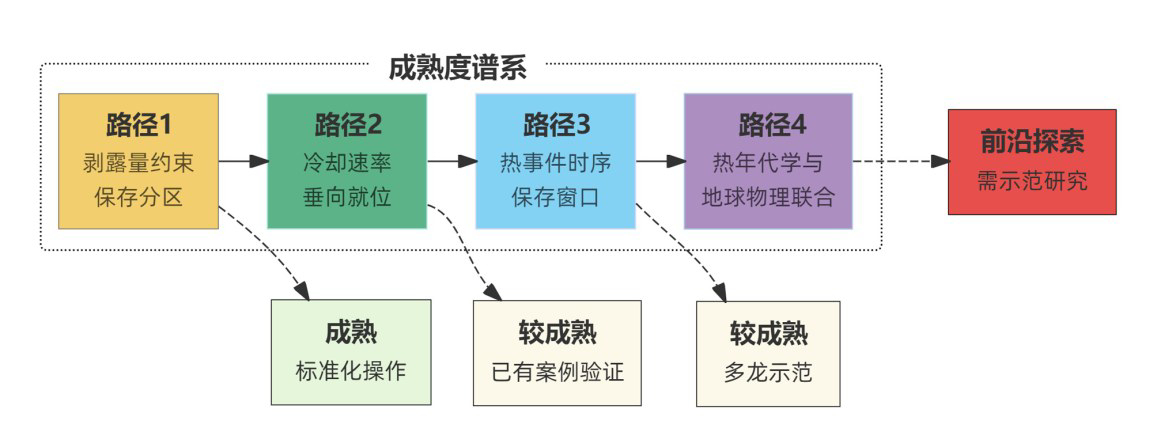
图2低温热年代学勘查转化路径的成熟度谱系
注:4条路径按照从成熟到前沿的梯度排列,反映了方法体系的递进逻辑与工程应用层次。
3.2.1 剥露量约束与保存分区
这是低温热年代学成果应用最直接、最成熟的转化形式(图2中黄色区域),其核心指标包括矿物冷却年龄-高程梯度(dAge/dElev)与热史反演T-t路径的深度积分。在具备足够地形高差的研究区,稳态剥露条件下不同高程样品的冷却年龄差可线性换算为长期剥露速率;在复杂构造区,则需借助 QTQt等软件反演热史路径,结合古地温梯度将冷却历史积分计算为累积剥露量(ΔH)。将区域内各采样点的 ΔH 与独立约束的成矿深度(H0)进行空间叠合,即可依据Ⅰ类(保存良好,ΔH<0.5H0)、Ⅱ类(部分保存,0.5H0≤ΔH<H0)、Ⅲ类(严重剥蚀,ΔH≥H0)的保存等级标准,编制保存潜力分区图及剥露量等值线图。该路径已在胶东金矿带成功应用,圈定了剥露量小于5 km的Ⅰ类保存区,成为当前勘查转化中最成熟的操作范式。
3.2.2 冷却速率与矿体垂向就位判别
当矿区成矿深度因缺乏可靠独立约束而难以精确量化时,冷却速率可作为定性判断矿体垂向就位状态的有效指标(图2中绿色区域)。岩浆热液矿床的垂向热结构通常呈现浅部温度梯度大、深部梯度缓的固有特征。成矿后若经历快速冷却(>10℃/ Myr),表明上覆岩层已被大量移除,当前地表可能已出露矿体根部带;若表现为持续缓慢冷却(<3℃/ Myr),则矿体顶部乃至前缘蚀变带可能得以保存。该方法可通过“矿物对”年龄差(ΔAge)或热史路径斜率(dT/dt)快速判别,尤其适用于勘查初期的快速筛选,可直接产出矿体垂向就位深度示意图及勘查风险分级图。
3.2.3 热事件时序与保存窗口识别
对于经历多期构造变动的复合造山带,单一的累积剥露量指标可能掩盖矿床曾经历的埋藏-再剥露过程(图2中蓝色区域)。低温热年代学能够通过多体系封闭温度年龄的阶段性分布,以及反演热史中的等温段,有效识别构造稳定期乃至埋藏增温期。这类时段即为矿床的有利“保存窗口”,对应矿体保存的最佳构造条件。例如,西藏多龙矿集区的热史反演揭示了成矿后的一次大规模碰撞期埋藏事件,上覆岩层增厚达 4 km,实质上为矿体提供了 “构造保护盖层”。这一发现将保存条件评价从静态的“剥蚀量”评估提升为动态的“剥蚀-埋藏旋回” 分析,对于构造复杂区的找矿部署具有重要指导意义。据此可产出的勘查产品包括剥蚀-埋藏时序柱状图及保存窗口时空分布图。
表3基于低温热年代学指标的矿床保存潜力评价与勘查转化路径

3.2.4 热年代学-地球物理联合约束
为进一步降低深部预测的不确定性,可将剥露量的空间分布(ΔH(x,y))与重力、磁法、电法等地物理数据(ρ、σ、χ)进行空间叠合分析(图2中紫色区域)。其中,剥露量等值线图约束了近地表矿体的保存状态,地球物理异常则揭示了深部是否存在隐伏矿化体。若某一区段同时落入“低剥露量”与“高成矿相关异常”的叠合区(即“浅保存+深异常”重合区),则其深部找矿潜力将显著增大。该方法目前在方法学层面已基本成熟,产出产品为多源信息融合的综合成矿潜力图,但仍需在重点矿集区开展更多针对性的示范研究加以验证,是低温热年代学领域多方法融合的重要发展方向。
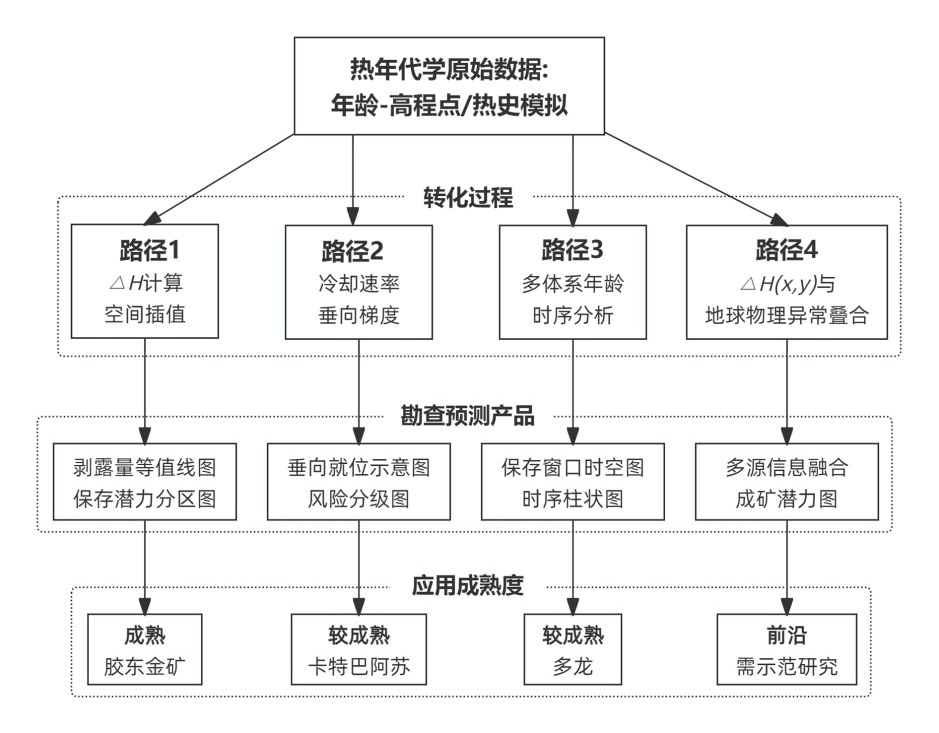
图3从原始热年代学数据到勘查预测产品的全链条转化路径
注:图示清晰展示了 4条路径的数据流、产物及成熟度梯度,为实际勘查工作提供了可操作的方法指南。
基于上述4条路径的详细论述,图3与表3分别从逻辑框架与参数体系两个维度给出了系统性展示。以下进一步提炼这4条路径的共性逻辑与选择原则。
4 条转化路径共同构建了一个从“冷却年龄数据”到“找矿决策产品”的完整技术链条。这一链条的核心逻辑可概括为:以剥露量(ΔH)为统一量化标尺,以成矿深度(H0)为约束基准,以剥蚀-埋藏旋回为动态视角,以多方法融合为降维手段。在具体操作中,路径的选择需遵循以下决策原则:
(1)成熟度优先原则:在勘查初期或数据获取成本受限时,优先采用路径1(剥露量约束)与路径2 (冷却速率判别),二者已形成成熟的标准化操作流程。
(2)复杂度匹配原则:对于构造活动强烈且存在多期热事件的造山带,需升级至路径3(热事件时序与保存窗口),方能准确识别关键保存时段。
(3)立体验证原则:当深部预测存在较大不确定性时,应引入路径 4(热年代学-地球物理联合),通过地表剥露量与深部地球物理异常的耦合分析,实现从“二维平面评价”向“三维立体预测”的跨越。
4 条路径并非相互排斥,而是构成了一个可分级、可组合、可拓展的方法谱系。未来研究应重点关注以下方向:(1)构建不同构造域下ΔH与H0的定量函数关系,建立具有物理基础的剥蚀-保存转换模型;(2)发展机器学习驱动的热年代学-地球物理联合反演策略,提升深部预测的精度与效率;(3)推动从已知矿床的“事后评估”向未知区“找矿前预测”的范式转换,即从单个矿集区的精细解析走向区域尺度的成矿潜力空间评价。这一方法谱系的完善,将真正打通从“年龄数据”到“找矿决策”的高效转化链条。
4 前沿进展与未来展望
低温热年代学在矿床剥蚀研究中的应用正处于快速发展期。近年来,分析技术的深化、定年对象的拓展以及大数据与机器学习方法的引入,正推动该领域从单矿物、小样本的精细解析向多体系、大数据驱动的系统评价迈进。本章从技术方法创新、多学科交叉融合与关键科学问题 3 个层面梳理前沿动态并展望未来方向。
4.1 技术方法创新
4.1.1 原位微区与成像技术
针对矿床中微细复杂热液矿物(粒径常小于 100 μm)难以用传统体相方法获取纯净样品的难题,原位微区分析技术已成为突破的关键。二次离子质谱(SIMS)微区 U-Th-Pb 定年技术以微米级空间分辨率实现了对热液成因新生副矿物的直接定年(Rasmussen and Muhling,2007;廖鑫,2021)。与此同时,激光剥蚀电感耦合等离子体质谱(LA-ICP-MS)原位裂变径迹分析无需中子辐照即可快速获取年龄信息,原子力显微镜(AFM)辅助径迹统计则提升了测量精度。未来,建立适用于矿床微细矿物的 “原位热年代学”标准化流程,将推动中低温热液矿床年代学研究从间接推断走向直接测定。
4.1.2 低温热年代学体系的深化与拓展
(U-Th)/He 定年技术的理论深化与对象拓展是近年最活跃的前沿之一。在基础理论方面,辐射损伤累积与退火模型(RDAAM)提出近二十年来,辐射损伤对 He扩散行为的控制机制持续得到修正与完善(Flowers,2025),这为复杂热历史条件下数据的精细解译提供了更坚实的物理基础。在矿物对象上,针对磷灰石在高辐射损伤、多期热叠加等复杂环境中的分析技术改进取得实质进展(Martin and Martinez,2025),显著提升了数据质量与解译可靠性。更值得关注的是,非传统矿物(如碳酸盐、氧化物)的(U-Th)/He 定年技术迅速发展(Guenthner and Li,2026),有望填补传统磷灰石-锆石体系在极浅部和极古老地质过程记录上的温标空白。陈玉柳等 (2024)则系统总结了新生矿物(U-Th)/He 热年代学的前沿进展,指出其在热液矿床直接定年与剥蚀历史重建中的独特价值。
与此同时,以石英光释光(OSL)热年代学(封闭温度<50℃)为代表的超低温技术正在有效弥补传统方法对第四纪极浅部剥蚀历史分辨率不足的缺陷(King et al.,2016;Ogata and Sueoka,2021)。上述技术进展与传统的磷灰石、锆石(U-Th)/He和裂变径迹方法相互补充,共同构建了从深部结晶到近地表剥露、从百万年尺度到千年尺度全覆盖的热年代学技术谱系(表4)。
表4矿床剥蚀研究的低温热年代学技术发展路线

4.1.3 大数据与机器学习
热历史反演本质上是高维非线性优化问题。近年来,机器学习算法被引入热年代学领域,在正向预测与逆向反演效率提升、不确定性量化等方面展现出潜力。然而,该方向仍面临训练数据不足、模型物理可解释性弱等瓶颈。Wilson and Evans (2025)系统评述了机器学习与(U-Th)/He 热年代学在预测性矿产勘查中的融合路径,指出通过训练海量热年代学数据与矿床保存状态的映射关系,有望构建具有空间预测能力的勘查模型。Zhao et al. (2026)则利用大数据驱动的分析方法揭示了区域剥露模式的统计规律,为从个例研究走向区域评价提供了可操作的技术方案。这些进展表明,“数据驱动+物理模型”的双引擎研究范式正在形成,但短期内仍以辅助传统反演为主。
4.2 多学科交叉融合
低温热年代学记录的是百万年尺度的平均剥露速率,而宇宙成因核素(如10Be、26Al)对千年尺度的地表剥蚀过程敏感,两者在时间尺度上天然互补。在低温热年代学约束的长期剥蚀背景上叠加宇宙成因核素揭示的晚第四纪剥蚀速率变化,可有效识别近期加速剥蚀事件及其对浅成矿床暴露风险的影响。
数值模拟方面,以 Pecube、FastScape 等为代表的耦合地表过程-热传导-构造变形的平台,能够将离散的热年代学数据同化为四维剥露过程重建,为成矿后构造-剥蚀-保存的全过程动态再现提供支撑。空间外推方面,利用热年代学年龄与地形参数、地球物理数据的关联分析,可提升区域剥蚀模式预测的可靠性。
图4将上述交叉路径整合为以低温热年代学为枢纽的多学科协同框架。其核心启示在于:低温热年代学的未来突破,不仅依赖自身技术进步,更取决于与宇宙成因核素、地球物理、数值模拟及机器学习等领域在数据、模型与目标层面的深度融合。
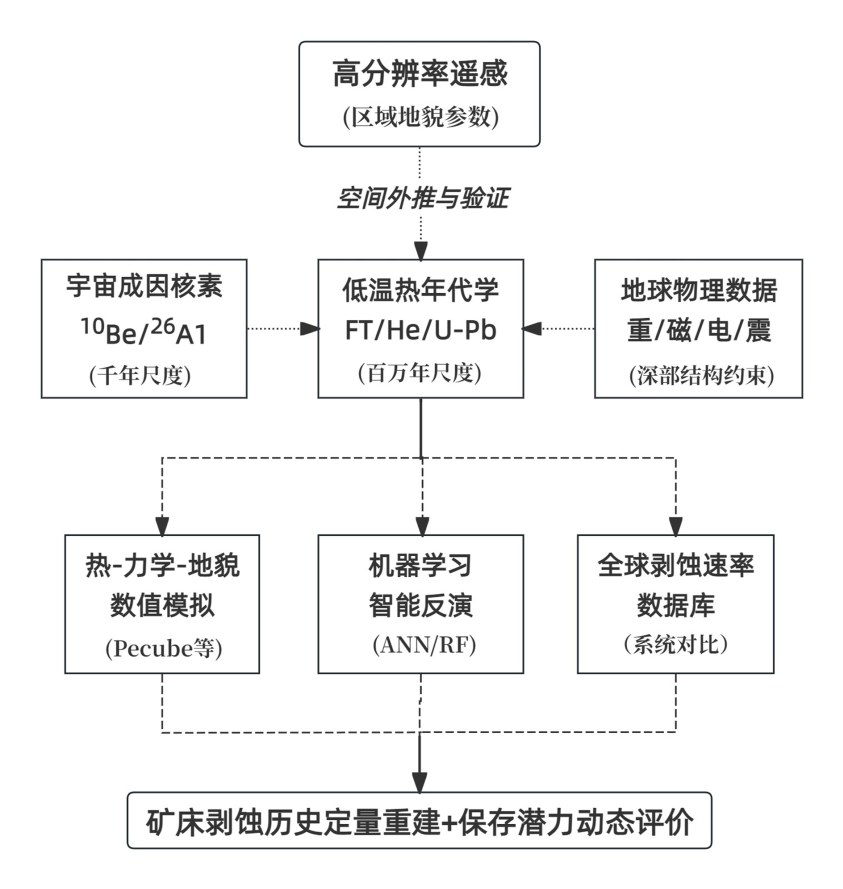
图4低温热年代学-多学科交叉融合研究框架
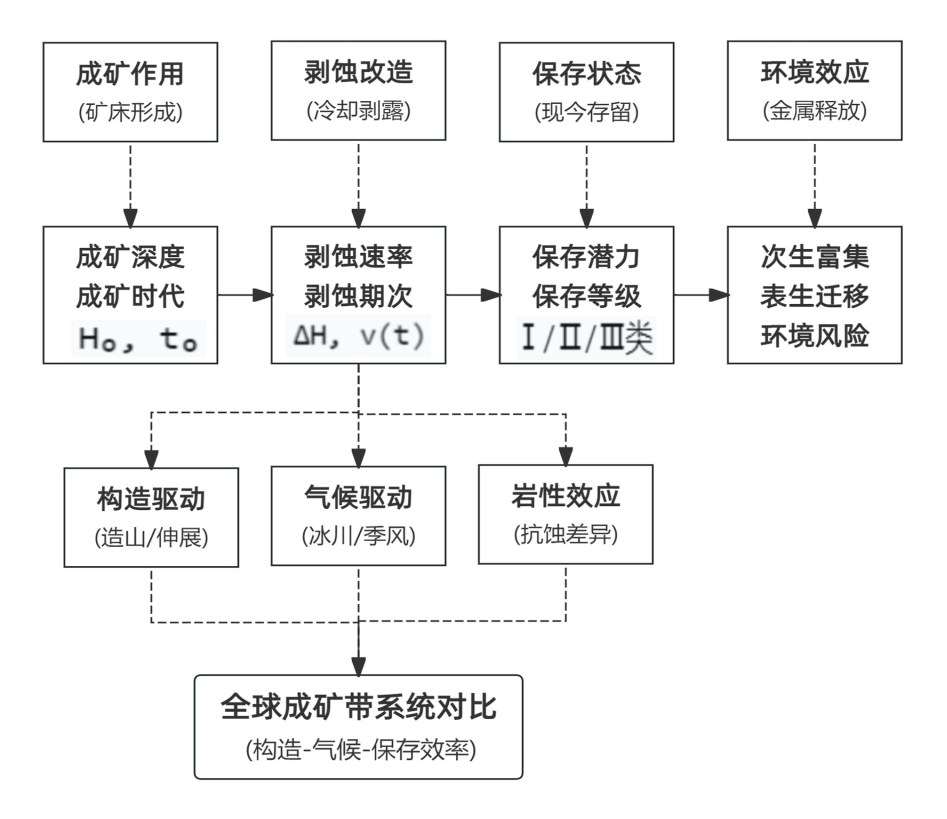
图5矿床“成矿-剥蚀-保存-环境效应”全生命周期研究框架
4.3 关键科学问题前瞻
当前矿床剥蚀研究正从单一矿床的孤立分析向多因素耦合、多尺度集成的系统科学转变。以下 3 个科学问题构成了本领域未来研究的关键突破口。
极端气候事件(冰川作用、季风强化)对矿床剥蚀的加速机制及其在热年代学记录中的可辨识“指纹”,是准确评估气候敏感区矿床保存条件的理论前提。矿床剥蚀过程与金属表生风化、次生富集及环境效应的耦合关系,则将保存条件评价从“矿体是否还在”拓展为“金属如何再分配”,兼具成矿理论与环境管理双重价值。全球主要成矿带剥蚀模式的系统对比,亟需构建开放共享的剥蚀速率数据库,以揭示构造体制、气候背景与矿床保存效率之间的内在关系,为区域成矿潜力评估提供宏观约束。
图5以矿床“全生命周期”为时间轴,将成矿作用、剥蚀改造、保存状态与环境效应串联为一个逻辑闭环,为上述科学问题在矿床演化链条中的定位提供了概念框架。
5 结论
本文系统综述了低温热年代学在矿床剥蚀速率研究中的应用进展,主要认识如下:
(1)方法体系层面,低温热年代学已从提供单一冷却年龄的工具,发展为一套基于物理动力学模型的综合性方法学。裂变径迹与(U-Th)/He 两大体系均完成了从静态“封闭温度”向动态“损伤累积-退火”模型的范式转变,显著提升了数据解译的定量精度。
(2)技术集成层面,多矿物联合剖面、蒙特卡罗数值模拟反演与空间采样协同设计,是构建连续热史约束、降低解译不确定性的核心策略,可将剥蚀量估算误差从公里级缩小至百米级。
(3)核心认识层面,矿床保存状态是构造抬升、气候剥蚀与岩性抗蚀性在时空上协同作用的结果。通过多体系数据联合约束与独立地质证据锚定,可有效消减反演多解性,推动剥蚀历史研究从单因素定性描述走向多因素耦合的概率性评价。控制方法选择与解译策略的3个核心地质变量——矿床年龄、构造活跃度、后期热事件强度——以及基于“剥蚀量-成矿深度”对比的 3 级保存等级(Ⅰ类:ΔH<0.5H0;Ⅱ类:0.5H0≤ΔH<H0;Ⅲ类:ΔH≥H0),为矿床保存条件的定量评估提供了通用准则。
(4)应用转化层面,剥露量约束与保存分区、冷却速率与矿体就位状态判别、多期剥蚀历史中保存窗口的识别,已形成可服务于勘查部署的实操路径,为深部找矿靶区优选提供了关键约束。
(5)未来方向层面,原位微区分析、超低温热年代学拓展、机器学习与大数据融合等技术的发展,将推动该领域从已知矿床的回顾性解释迈向未知区找矿潜力的前瞻性预测。
致谢 感谢评审专家的宝贵意见,以及编辑老师的辛勤付出。